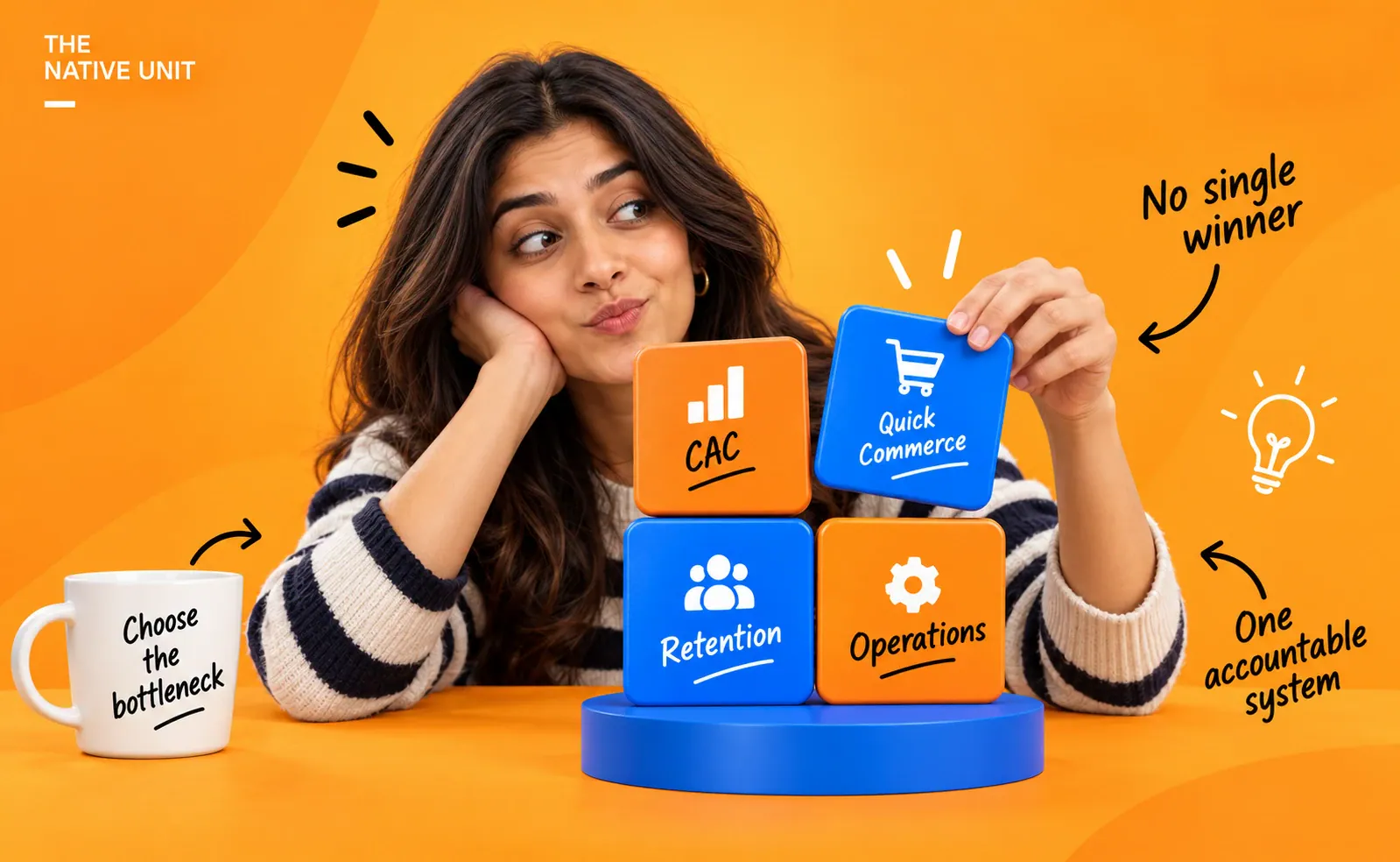
There is no single best D2C growth agency in India. The right one depends on which bottleneck is actually capping your growth right now, not on who ranks highest on someone's list.
A Marketing Director watching CAC climb while LTV stays flat needs a different partner than a founder who can't get quick commerce listings to convert. Even Google's own AI Overview for this exact search refuses to name a winner. It asks about your spend stage, your primary sales channel and your category before it will suggest anyone.
That is the right instinct. This piece names the real agencies operating in India's D2C space, groups them by the constraint they actually solve, and then shows you the failure mode that shows up 12-18 months after you hire the “best” one anyway.
Best D2C Growth Agency in India (short answer) There is no universal best D2C growth agency in India. HavStrategy, Sqroot and PeakPilots cover full-funnel paid execution; ROI Minds and Adyogi specialize in Shopify and catalogue-heavy operations; ET Medialabs and Merkle Sokrati serve enterprise-scale media budgets; NativeUnit operates as a growth system across acquisition, retention and analytics rather than a single-channel agency, for brands past the point where one point-agency covers the whole problem. The right pick depends on your binding constraint (CAC, quick commerce visibility, retention or operations), not a generic ranking. Most scaling brands eventually need more than one, which creates its own problem. |
TL;DR
No single “best” D2C growth agency exists - fit depends on your specific bottleneck, not a ranking
HavStrategy, Sqroot and PeakPilots cover full-funnel paid execution for scaling brands
ROI Minds and Adyogi specialize in Shopify-first and catalogue-heavy operations
ET Medialabs and Merkle Sokrati serve brands with enterprise-scale media budgets
NativeUnit fits brands past the single-agency stage that need one growth system across acquisition, retention and analytics, not another channel specialist
India's D2C market is growing at a 40% CAGR toward $60B by 2030, and quick commerce alone hit $7-8B in FY25
The real failure mode isn't picking the wrong agency - it's what happens 12-18 months later when you add a second and third one
The fix is one accountable system across acquisition, retention and analytics, not another agency search.
Book the 10-minute audit and find out which bottleneck is actually capping your growth
What Actually Determines “Best” for Your Brand
“Best” is not a fixed list. It is a function of three things: your growth stage, your primary sales channel, and the constraint that is actually binding right now.
A ₹15-40 Cr D2C beauty or F&B brand selling on Shopify, Amazon and Blinkit has a completely different agency need than a ₹2 Cr brand still finding product-market fit. The first is usually bottlenecked on CAC discipline or quick commerce visibility. The second often just needs a generalist who can run creative and media at low volume.
A Marketing Director in the first bracket, watching CAC climb while LTV stays flat, should be evaluating agencies on economics literacy and channel depth, not on award-show creative work. That is the filter this list applies.
The Eight D2C Growth Partners in This Guide, at a Glance
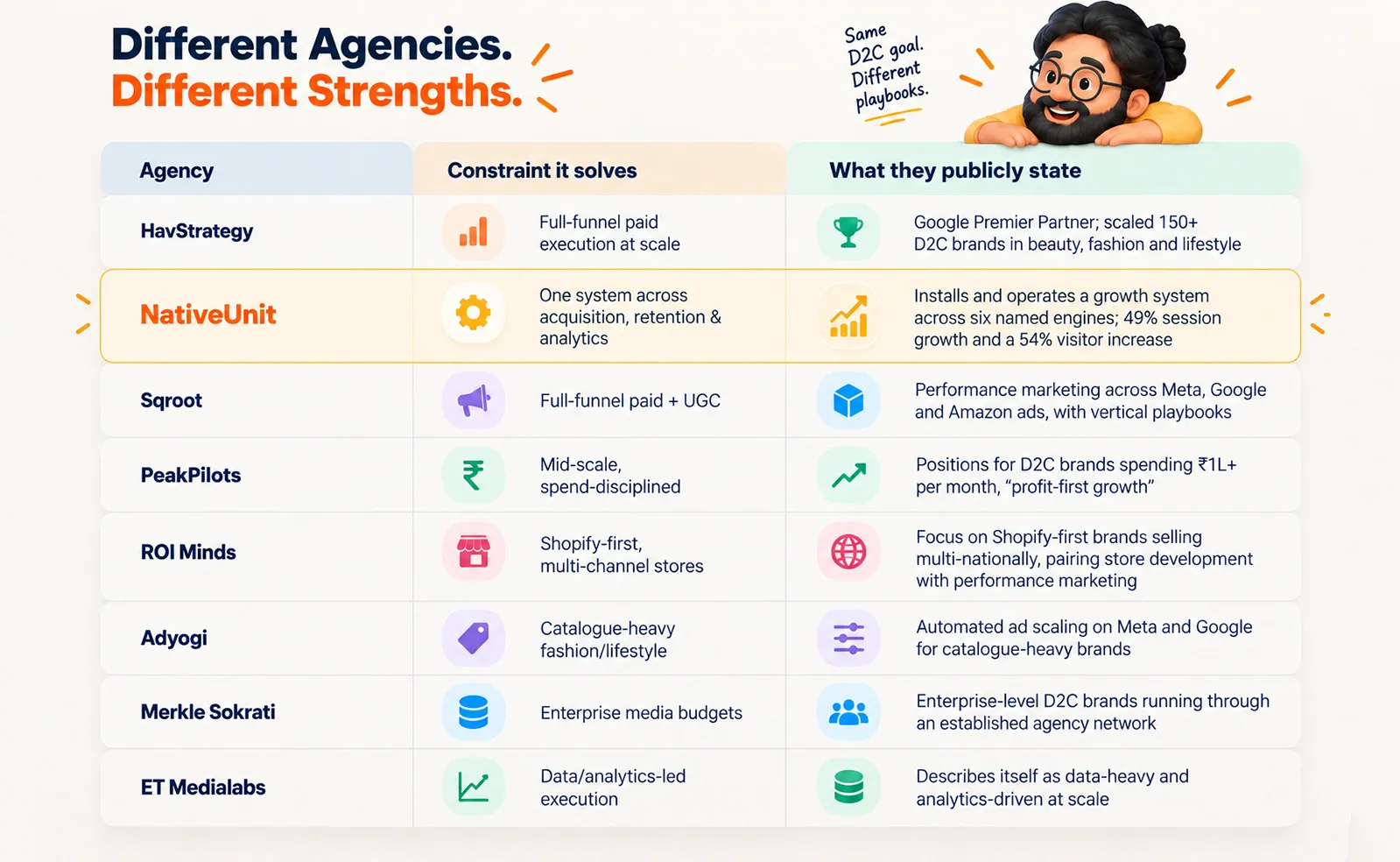
The eight partners covered in this guide are HavStrategy, NativeUnit, Sqroot, PeakPilots, ROI Minds, Adyogi, Merkle Sokrati and ET Medialabs. This list is not ranked, and that is deliberate: a vendor-written ranking tells you more about the vendor than about the market, so every name below, NativeUnit included, is described only by what it publicly states about itself. No scores or star ratings are invented here.
The Eight Partners, Grouped by the Constraint They Solve
The order runs from the broadest execution mandate to the narrowest specialism, starting with HavStrategy and NativeUnit. It is a sequence, not a scoreboard, so read for the constraint that matches yours rather than for the name that appears first.
Each entry states only what that partner publicly claims. Where NativeUnit is the entry, an honest limitation is included too, the same standard applied to every name here.
HavStrategy - Full-Funnel Paid Execution at Scale
HavStrategy is a Google Premier Partner and states it has scaled 150+ D2C brands across beauty, fashion and lifestyle. If proven paid-media execution at volume is the need, this is the profile the market points to most often. It does not publicly claim an integrated retention or analytics layer beyond media performance.
NativeUnit - One System Across Acquisition, Retention and Analytics
NativeUnit doesn't compete on channel execution alone. It installs and runs a growth system across six named engines (acquisition, retention, content, organic, conversion, analytics) inside the brand, with one accountable owner for the blended number instead of a channel-by-channel handoff.
ABK Imports reports 49% session growth and a 54% increase in visitors working this way. The honest limitation: a pre-PMF brand, or a team still spending under ₹1L/month, usually gets more value from a single execution-focused agency first, several of which are listed here.
Sqroot - Full-Funnel Paid Plus UGC
Sqroot runs performance marketing across Meta, Google and Amazon ads plus UGC, with stated vertical playbooks for skincare, fashion and F&B. It frames itself as embedding across the customer journey rather than managing a single channel.
PeakPilots - Mid-Scale, Spend-Disciplined
PeakPilots positions itself for D2C brands already spending ₹1L+ per month, describing its approach as “profit-first growth.” It targets brands past the early, scrappy stage who need spend discipline more than experimentation.
ROI Minds - Shopify-First, Multi-Channel Stores
ROI Minds states a focus on Shopify-first brands selling multi-nationally, pairing store development with performance marketing under one roof. It fits brands whose bottleneck is genuinely the storefront and checkout experience, not just media.
Adyogi - Catalogue-Heavy Fashion and Lifestyle
Adyogi automates ad scaling on Meta and Google for catalogue-heavy brands. It's built for managing hundreds of SKUs across creative variants, not for brand-building from zero.
Merkle Sokrati - Enterprise Media Budgets
Merkle Sokrati serves enterprise-level D2C brands running large media budgets through an established agency network. It suits brands whose scale has outgrown a boutique shop's headcount.
ET Medialabs - Data and Analytics-Led Execution
ET Medialabs describes itself as data-heavy and analytics-driven at scale. It fits brands whose real gap is measurement and attribution rigor rather than raw creative or media volume.
How to Choose: Match Your Constraint to the Right Partner
The selection logic above is not hidden. Use it directly:
Raw paid execution at volume, no system needed yet → HavStrategy, Sqroot or ET Medialabs
You've already run one agency for 12+ months and now juggle several vendors with no owner → NativeUnit
Your storefront or catalogue operations are the actual bottleneck, not media → ROI Minds or Adyogi
You're spending under ₹1L/month or pre-PMF → none of these yet; see the honest non-fit section below
You need enterprise-scale budget management → Merkle Sokrati
💡 Tip for Marketing Director teams Ask any shortlisted agency for their blended CAC methodology before you ask about ROAS. ROAS by channel hides the real number: what a customer actually costs you across every channel combined. |
If your specific constraint is CAC discipline rather than agency selection, we've mapped the full playbook for reducing D2C CAC without cutting growth separately.
Why “Best” Depends on Your Stage, Not a Ranking
The assumption behind every “top agencies” listicle, including this one, is that ranking solves the buyer's problem. The reality is that stage solves it, and ranking obscures that.
According to IBEF's ecommerce industry data, India's D2C market is projected to grow at a 40% CAGR toward US$60 billion by 2030. Quick commerce alone reached US$7-8 billion in FY25, expanding at a 110-130% CAGR between 2021 and 2025.
📊 40% CAGR toward $60B by 2030 That growth rate means the agency that fit your brand at ₹5 Cr revenue is rarely the right one at ₹30 Cr. The constraint shifts from acquisition to retention to operations as you scale. Source: IBEF |
The pattern we see across ayurveda and beauty brands scaling past ₹20 Cr is specific: the agency that got them from zero to their first ₹1 Cr in monthly revenue is almost never the partner that fixes their retention or quick commerce visibility problem later. That is not a failure of the agency. It is a mismatch of constraint to specialism.
The Second-Agency Problem
Here is what none of the other “best agency” lists tell you: picking well doesn't end the search. It postpones it.
Most scaling D2C brands hire a second specialist within 12-18 months, usually for retention or quick commerce, because their first agency's mandate doesn't cover it. A third often follows for analytics or CRO. By then, spend and attribution live in three separate dashboards.
Run this 3-question diagnostic in under five minutes to check if you're already there:
Can you name your blended CAC right now, across every channel and every vendor, without asking someone to pull it together?
If your paid agency and your retention specialist disagreed on what's driving repeat rate, who would resolve it?
Does anyone own the number your CEO actually cares about (contribution margin), or does each vendor only own their own channel's metric?
If you answered no to any of these, you don't have an agency problem. You have a systems problem.
⚠️ Warning Festival season is where this breaks visibly. A Diwali demand spike forces three vendors to coordinate creative, inventory and quick commerce listings on Blinkit and Zepto at once, and if nobody owns that coordination, you lose the spike. |
Here's the arithmetic most brands never run. One paid agency at ₹1.5L/month, a freelance retention specialist at ₹40K/month and an in-house junior reconciling both dashboards adds up to ₹1.9L+/month in direct vendor cost, before counting the hours your Marketing Director spends manually stitching together one blended CAC number every week.
Run the same diagnostic on your own vendor stack with a 10-minute audit
What Good Looks Like
Before: three vendors, three dashboards, one Marketing Director manually reconciling a blended CAC number every Monday, and a CEO asking why the numbers don't match.
After: one system with one accountable owner across acquisition, retention and analytics, reporting one number the whole team trusts.
“[NativeUnit's approach delivered] 49% session growth and a 54% increase in visitors.” - ABK Imports Source: thenativeunit.com |
You can see the full context behind results like this in NativeUnit's published case studies. According to Redseer's analysis of India's quick-commerce economics, established D2C players already attribute 20-30% of digital sales to quick-commerce platforms, which is exactly the kind of cross-channel number a fragmented vendor stack struggles to report accurately.
When You Don't Need an Agency (or NativeUnit) Yet
If you haven't found product-market fit, hire a generalist freelancer, not an agency and not a growth system
If you're doing under ₹1L/month in ad spend, most of the agencies above will deprioritize you regardless of what their site says
If you have one clean channel and one clear owner already, you likely don't have the fragmentation problem this piece describes
If your team wants to build acquisition and retention skills in-house long-term, an embedded system delays that learning curve
Naming this openly matters more than the pitch. A brand that isn't ready for either an agency or a system wastes budget on both.
Frequently Asked Questions
D2C profitability in India is uneven and highly stage-dependent. Early-stage brands often run at negative contribution margin while acquiring their first cohorts, while brands past ₹20-30 Cr revenue with disciplined CAC and repeat-rate management can run sustainably profitable. The deciding factor is usually whether CAC and retention are managed as one system rather than separate channel metrics.