
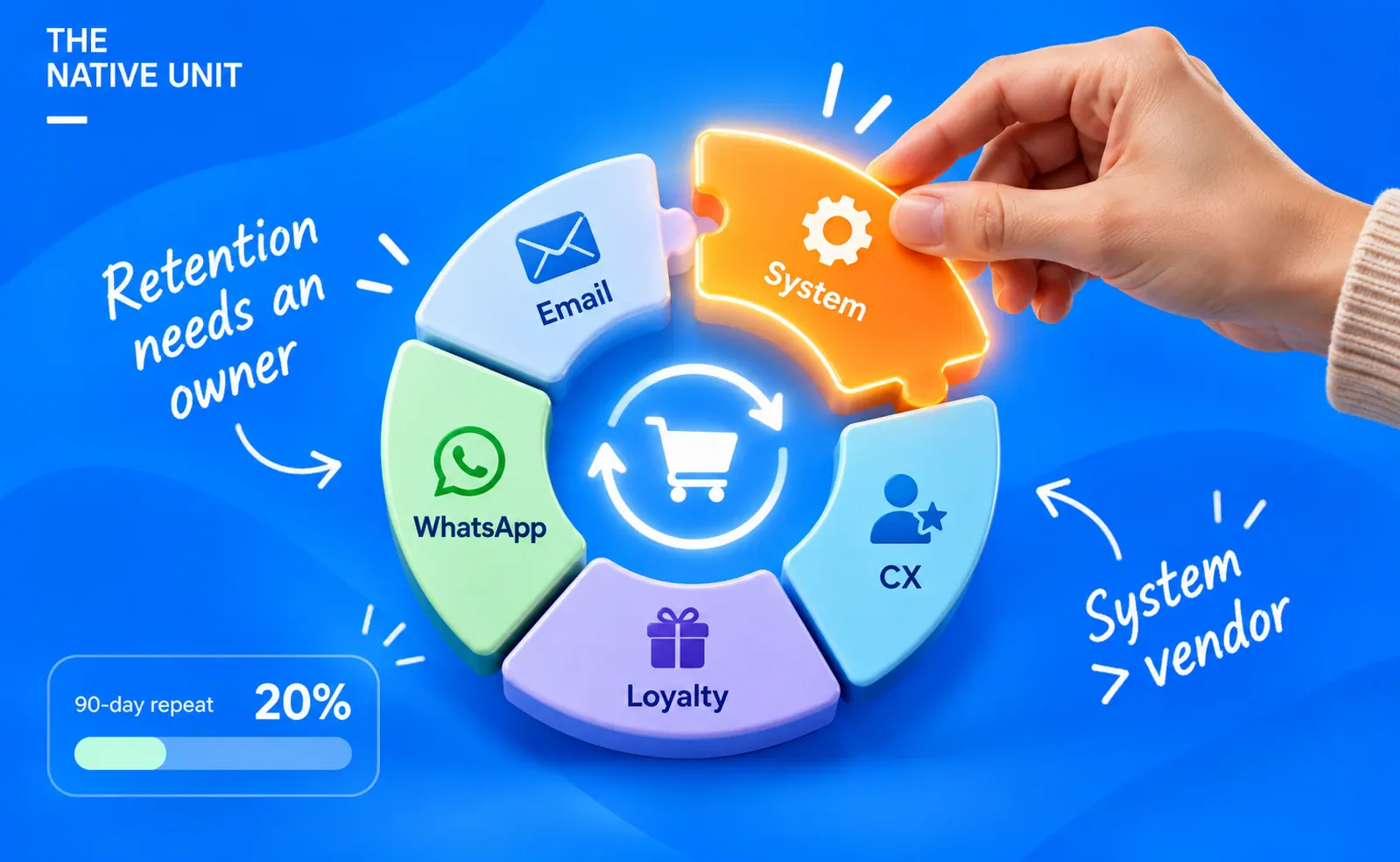
Do You Need a Retention Marketing Agency in India? Hire one only after you've measured your 90-day repeat purchase rate against the 20% baseline and confirmed nobody owns fixing it full time. If you're below 20% and retention is already someone's whole job, the fix is usually a system change, not a new vendor. If nobody owns the number, a partner that runs retention as a system, not a set of email flows, is the faster path. |
TL;DR
A retention marketing agency in India earns its cost when repeat purchase rate has stalled AND no one owns fixing it full time.
Unicommerce's 2026 data (6,000+ D2C brands) puts the 90-day repeat-rate bar at 20%; below that, you're not yet a durable D2C brand by their own read.
The real failure is usually ownership, not tactics: acquisition gets a budget line by default, retention doesn't.
NativeUnit's Post Purchase Silence bottleneck names this gap; the Retention & LTV Engine is the system built to close it.
The 90-Day Silence Audit is a 5-minute self-check showing whether you have a content problem, a system problem, or neither.
Festive-season COD RTO alone can erase acquisition spend before retention even enters the picture.
Insurgent Indian D2C brands grow 1.5-5x faster than their categories (IBEF), which is exactly why their retention systems fall behind first.This isn't a fit for every brand. The closing section names who shouldn't hire anyone yet.
See which side of this gap is costing you more. |
What Actually Counts as a Retention Problem
Repeat purchase rate is the number that separates a real D2C brand from a brand that's renting its customers every month. The formula: customers who ordered again in a period, divided by total customers in the starting cohort, multiplied by 100.
📊 20% is the 90-day bar, not the goal Unicommerce's India D2C Report 2026, built from 410 million shipments across 6,000+ brands, states it bluntly: a 90-day repeat rate below 20% means a brand doesn't meet their bar for “a D2C brand” at all. Above 30% is where retention starts compounding faster than acquisition can buy. *Source: Unicommerce, India D2C Report 2026* |
A Marketing Director at a ₹25 Cr personal care brand spending ₹18L a month on Meta and Google ads usually finds the number here first. CAC isn't the problem. The problem is that every rupee of that CAC buys a customer who orders once and disappears.
This is NativeUnit's Post Purchase Silence bottleneck: after buying, customers hear nothing until the next generic offer lands in their inbox. It isn't a copywriting gap. It's a system nobody assigned.
Why the Usual Fix Fails
The assumption most brands act on is that retention is a tactics problem. Add a post-purchase email flow, launch a loyalty program, run a WhatsApp broadcast, and repeat rate should climb.
The reality is different. Retention fails in most D2C teams not because the tactics are wrong, but because nobody owns the number as their primary job. Acquisition gets a dashboard, a weekly standup and a media budget approved every month by default.
📊 Growth outruns the system that should catch it Insurgent Indian D2C brands grow 1.5 to 5 times faster than the categories they compete in, largely through digital-first acquisition. That speed is exactly why their retention systems fall behind first: nobody builds a retention rhythm at the pace acquisition scales. *Source: IBEF* |
Loyalty points and win-back flows aren't wrong on their own. They're symptoms of a system nobody built, bolted onto a channel nobody was ever assigned to own.
How the Retention and LTV Engine Actually Works
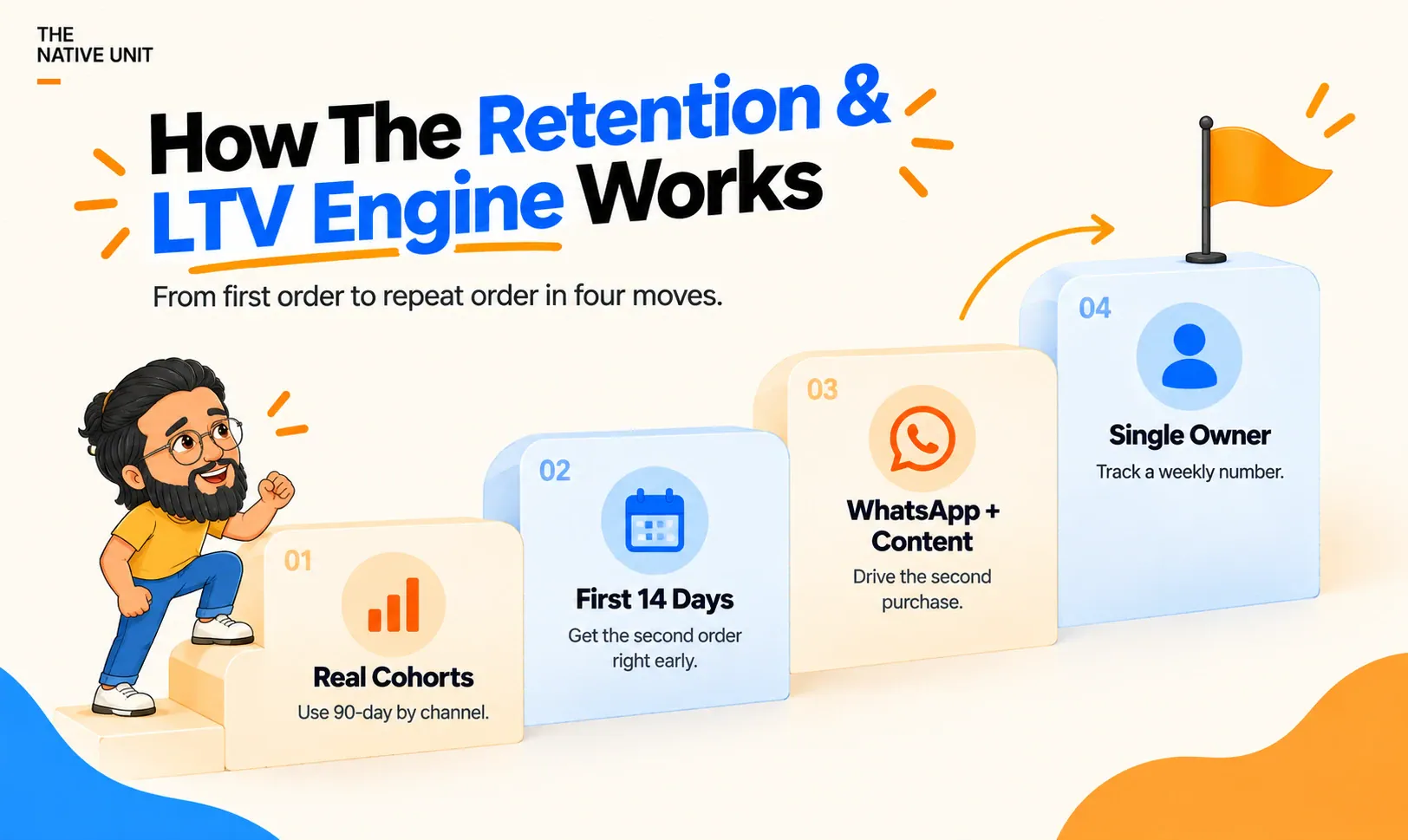
Fixing Post Purchase Silence isn't one tactic. It's four moves, run in sequence, owned by one system instead of scattered across marketing, support and whoever has time.
Measure the real cohort number first. Most teams quote a lifetime repeat rate that hides a collapsing 90-day number. NativeUnit's Retention & LTV Engine starts by isolating the 90-day figure per acquisition channel, because a customer acquired through a festival sale behaves differently from one acquired through organic search.
Fix the first 14 days, not the whole lifecycle. Indian D2C data consistently shows the second-purchase decision gets made early. A COD order that survives delivery without an RTO event is the single best predictor of a second order. A customer whose first parcel never arrives rarely orders again, regardless of what the loyalty program offers later.
Build the WhatsApp and content layer around the second purchase specifically, not a generic newsletter cadence. WhatsApp consistently outperforms email for transactional and reminder flows in the Indian market, and the Content & Influence Engine feeds it real usage content instead of another discount code.
Put a single owner and a weekly number on it. This is the step most brands skip. Acquisition without a dashboard would never survive a week internally. Retention without one survives for years, quietly, which is worse.
The pattern across personal care and F&B brands scaling past ₹20 Cr is specific: the brands that stall are rarely the ones with a weak loyalty program. They're the ones where the first fourteen days after purchase belong to nobody.
The 90-Day Silence Audit
This is the diagnostic NativeUnit runs before proposing anything. It takes under five minutes and tells you whether the fix is content, system or ownership.
💡 Run it right now Pull your last 90 days of first-time buyers. Count every marketing touch they received beyond the automated shipping update: WhatsApp, email, SMS, retargeting. Write down the exact day the silence started. If silence started on day one, this is a system gap. If it started around day thirty, your first flow works and your second one doesn't exist yet. |
Most brands expect this audit to surface a content problem. What they find instead is a calendar with nothing scheduled between the shipping confirmation and the next site-wide sale, sometimes six or eight weeks apart. That gap is the entire Post Purchase Silence bottleneck, visible in one screenshot.
The pattern we see running this audit for brands is consistent: the silence is never intentional. It's just the first casualty when nobody's job description includes day 15 through day 45.
Don't just self-diagnose. |
What Good Looks Like
Here's the difference a working system makes, in numbers a founder can check.
| Silence (typical) | System (target) |
First marketing touch after purchase | Shipping update only | WhatsApp + content within 48 hours |
Days of silence before next touch | 30-60 | 0, scheduled through day 45 |
90-day repeat rate | Below 20% | 30%+ |
Who owns the number | Nobody specifically | Retention & LTV Engine |
This matches what Deloitte's 2024 Consumer Loyalty Survey of 9,800+ consumers across markets including India found: 86% rate financial rewards and simplicity, not novelty, as the loyalty attributes that matter most. A system that makes the fifth purchase as easy as the first beats a cleverer rewards program every time.
⚠️ The trade-off nobody states upfront A real retention system costs attention before it saves money. It needs product, support and marketing to share one calendar. Brands that want a plugin instead of a system usually abandon it within a quarter, and the repeat rate reverts. |
Here's the math on why the lift is worth the friction. A brand acquiring 2,000 new customers a month at a blended CAC of ₹450 spends ₹9 lakh a month to acquire them. At the 20% 90-day baseline, 400 of those customers order again within the quarter. Lift that cohort to 30% and 600 order again instead: 200 additional repeat orders at a ₹900 average order value, or roughly ₹1.8 lakh recovered from spend the brand already committed. This is an illustrative model built from stated assumptions, not a measured client result. Substitute your own numbers.
NativeUnit's own published work spans brands like ABK Imports, Phynart, Mrs. Foodrite and Warana, each with a named, public result on NativeUnit's case studies page. Separately, NativeUnit reports a 1.4X ROAS improvement without additional spend across its acquisition work, a reminder that the acquisition and retention sides of this system are meant to compound, not compete.
When a Retention Marketing Agency Isn't Your Answer
A retention marketing agency, including NativeUnit, is the wrong purchase in a few specific situations.
Pre-PMF brands. If the core product hasn't found consistent first-time demand yet, fixing repeat purchase rate is solving the wrong problem. Fix acquisition and product-market fit first.
Sub-₹1L monthly ad spend. Below this, the fixed cost of running a dedicated retention system usually exceeds what it recovers. One owner doing manual WhatsApp follow-ups will outperform any system at this size.
Brands with one clean owned channel already compounding. If a brand's own site or app already drives 40%+ repeat purchases through a channel it controls, the marginal system upgrade is smaller than it looks.
If none of these describe your brand, and the 90-Day Silence Audit above showed a real gap, that's the point where a dedicated system, not another tactic, is the faster path. If acquisition cost itself is the binding constraint right now instead, NativeUnit's breakdown of where D2C CAC actually leaks is the better place to start.
Not sure which of these three you are? That's what the free audit is actually for. Ten minutes tells you whether you have a retention problem worth solving, or something else entirely, no pitch either way.
The System That Should Own This
Retention vs acquisition isn't a debate about which matters more. Both engines have to run at once. The actual failure is structural: acquisition gets a system by default, and retention gets whatever is left over.
Fixing Post Purchase Silence doesn't require picking a side. It requires giving retention the same ownership, cadence and weekly number that acquisition has always had, whether that's NativeUnit's Retention & LTV Engine or a system built the same way in-house.
Run the 90-Day Silence Audit this week. Book a 10-Minute Audit and find out which engine owns your next quarter → |
Frequently Asked Questions
For an Indian D2C brand, a 90-day repeat purchase rate above 20% is the baseline for a durable brand, and above 30% is considered strong, per Unicommerce's 2026 transaction data across 6,000+ brands. Below 20%, the brand is still primarily acquisition-dependent regardless of revenue size.