
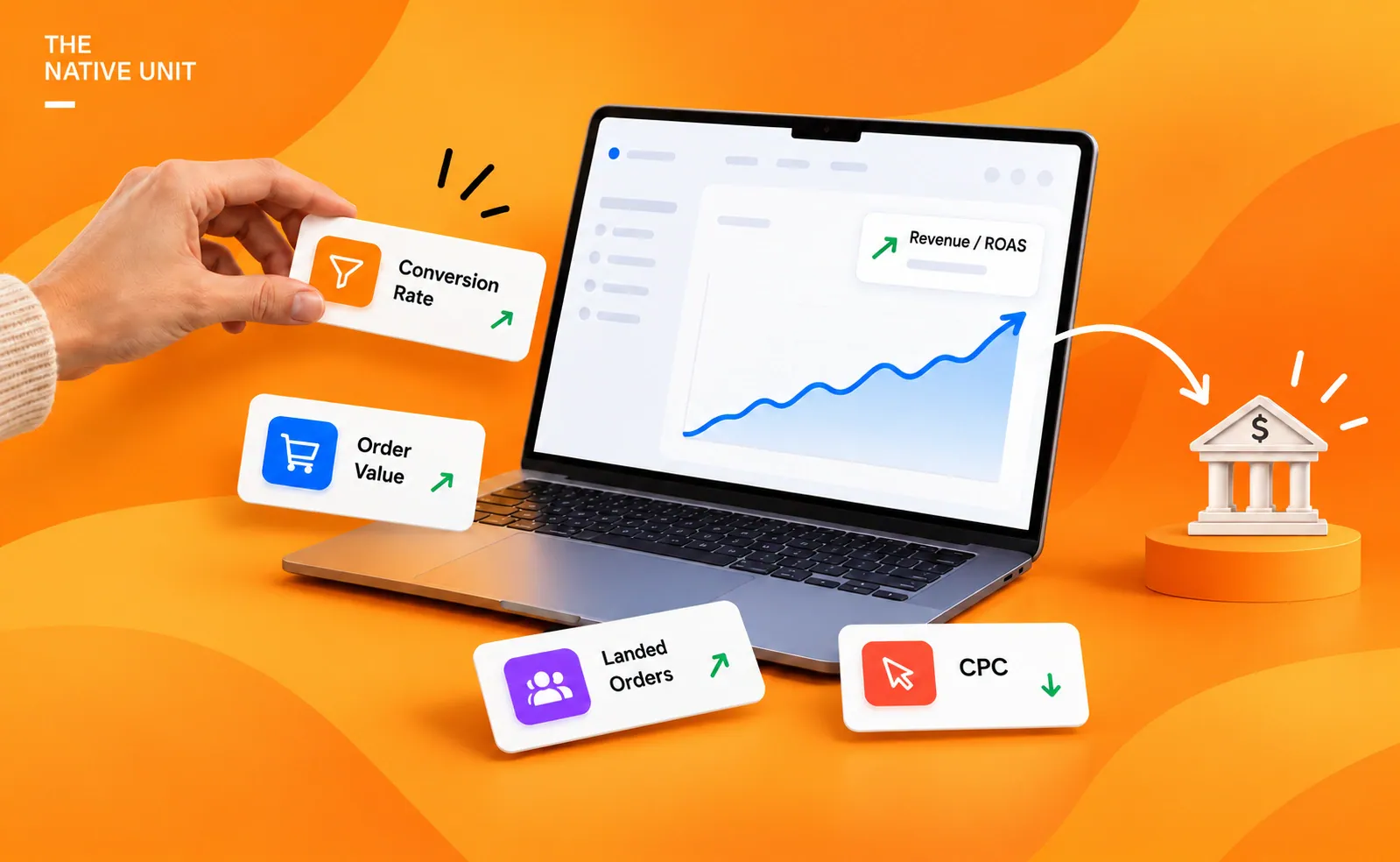
To improve ROAS, raise the revenue that actually reaches your bank for every ad rupee, not the number Ads Manager reports. For a D2C brand, that means fixing four terms: conversion rate, order value, the share of orders that land, and cost per click.
A Marketing Director watching CAC rise while LTV stays flat usually hears the opposite advice: rebuild audiences, swap creatives, raise the bid cap. Often that treats a system problem as a channel problem.
Only one of the four terms lives inside the ad account, while the product page, checkout and courier set the rest. NativeUnit calls this the No Unified Dashboard bottleneck: performance sits in five tools, so nobody sees the number the business banks. Its Customer Acquisition Engine fixes the terms, and its Analytics & ROI Engine owns the ledger.
ROAS (definition) ROAS, or return on ad spend, is ad-credited revenue divided by the spend that produced it. A ROAS of 3.0, also written 300%, means ₹3 of tracked revenue for every ₹1 spent. For an Indian D2C brand it signals profit only once you compare it with break-even ROAS and remove cancelled and RTO orders. |
TL;DR
ROAS is ad-credited revenue divided by ad spend.
A good ROAS clears break-even ROAS, which is 1 divided by contribution margin.
Four terms set ROAS: conversion rate, order value, landed rate and cost per click.
Only cost per click sits inside the ad account.
Illustrative: a 3.0 platform ROAS can be a ₹94,000 loss.
The week-one review checks structure, signal, creative cadence and budget logic.
Steady blended ROAS with falling platform ROAS means a measurement problem.
Run the four-term test on your account and fix the term that moved.
Get a free ad-account teardown and see which of the four terms is leaking → |
Why ROAS Looks Fine in Ads Manager and Feels Broken in the Bank
The assumption is that a weak ROAS is a media problem. The reality is that Ads Manager credits revenue at order placement, before cancellations, before the courier, and before anyone checks margin.
📊 3X ROAS on the dashboard can hide a 5% real margin Inc42's July 2026 report quotes Kae Capital warning that a brand can show 3X ROAS while its real profit margin is just 5%. It also notes brands increasingly track MER, blended CAC and contribution margin rather than ROAS alone. Source: Inc42 |
A Founder reading only the dashboard sees growth where the bank sees a busy P&L. That is the No Unified Dashboard bottleneck: the ad platform, the storefront, the courier and finance each hold one piece of the ratio.
If the pain is cost per new customer rather than return per rupee, our diagnostic to reduce customer acquisition cost is the better start.
How to Improve ROAS: Start With the Four-Term Test
ROAS is a ratio of four terms, and a move in any one of them moves the result.
ROAS = (Conversion Rate × Average Order Value × Landed Rate) ÷ Cost Per Click |
Landed rate is the share of orders that deliver and stay delivered. Here is the identity with illustrative inputs, not a client result:
Term | Illustrative value | Set by | Read it in |
Conversion rate (orders per click) | 2.4% | Product page, checkout, offer | Shopify or GA4 |
Average order value | ₹1,000 | Bundles, free-shipping threshold | Shopify |
Landed rate | 80% | Payment mix, address quality, courier | Courier and order data |
Cost per click | ₹8 | Creative, audience, auction | Ads Manager |
Plug them in: 0.024 × 1,000 × 0.8 ÷ 8 = 2.4. Ads Manager would show 3.0, because it counts the 20% of orders that never land.
Run the test in five minutes:
1. Pull each of the four terms for the last 30 days and the 30 days before.
2. Find the term with the biggest percentage move.
3. Assign that term to its owner and fix it before touching any campaign.
A COO asking whether the business is funding marketing chaos without operational ROI is really asking about the landed-rate term. The first fix is whichever term moved, not whichever campaign looks weakest.
Is 3x ROAS Good? Only If It Clears Your Break-Even
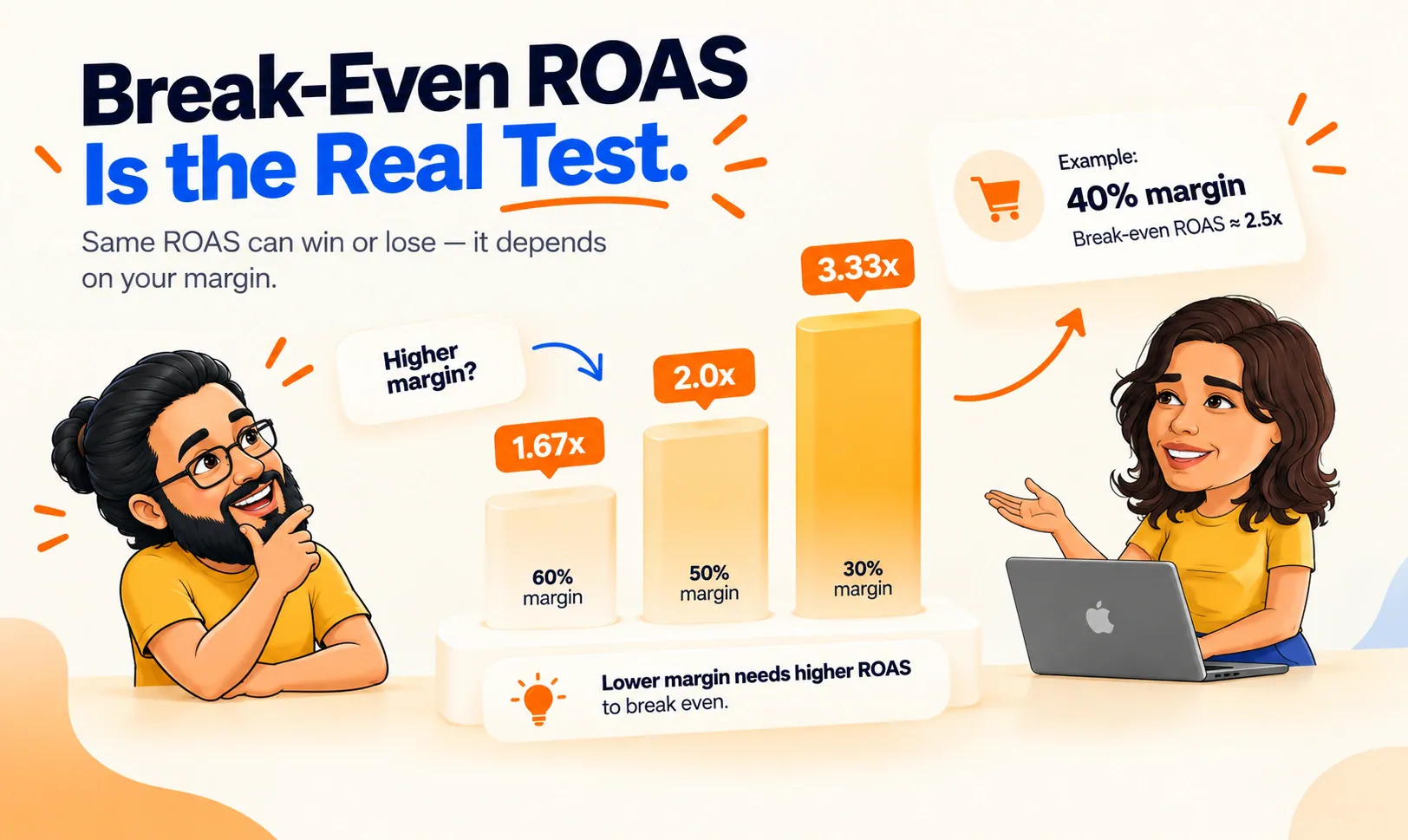
No ROAS figure is good on its own. It is good when it clears break-even ROAS, which is 1 divided by contribution margin. A brand keeping 40% after product cost, shipping, payment fees and packaging needs 2.5x to stop losing money.
Break-even moves with margin: 30% needs 3.33x, 50% needs 2x, 60% needs 1.67x. So a 3.0 clears a 40% margin, a 2.8 barely does, and a 3.8 loses money at 25%. A 9 is rarely a number to copy: a small, high-intent audience usually carries it, and the average hides a lower marginal return.
Take the illustrative brand: ₹10 lakh at ₹8 a click buys 1,25,000 clicks, which convert at 2.4% into 3,000 orders. Margin is 40%, and each order that never lands wastes ₹90 of shipping.
Ads Manager view: ₹30,00,000 credited at ROAS 3.0, so ₹12,00,000 of contribution and +₹2,00,000 after spend.
Landed view: 600 of 3,000 orders never land, leaving ₹24,00,000 and a landed ROAS of 2.4.
Contribution on landed revenue: ₹9,60,000, which is ₹40,000 short of spend.
Wasted shipping: 600 × ₹90 = ₹54,000.
Result: a ₹94,000 loss on a campaign the dashboard told the Founder was profitable.
📊 COD orders returned at 58% in the festive quarter Unicommerce's India D2C Report 2026 says COD orders returned at 58% during the festive quarter, while prepaid orders returned at under 15%. Your landed rate is weakest exactly when you spend hardest. Source: Unicommerce |
The same report says brands that cut RTO ran three changes together. They added a prepaid incentive at checkout, routed couriers by pin code on real delivery performance, and verified addresses before dispatch. Each is a landed-rate fix, not an ad fix.
Account Structure: Stop Funding Spend That Cannot Convert
A Brand Manager should ask one question first: where does spend go that had no chance of converting? The pattern that shows up first in a week-one review is retargeting carrying the account. It posts the highest ROAS, so it wins the budget, and prospecting is then judged against a number it can never match.
Separate prospecting from retargeting so one stops flattering the other, and exclude existing customers from prospecting. Pause ads and SKUs that drain budget without converting. On Google, keep brand search apart from Shopping and Performance Max reporting, prune search terms that never convert, and clean product feed titles.
Conversion Signal and Tracking Quality: Fix the Data Before the Bids
A Marketing Director reading three dashboards is tuning bids against a signal nobody has audited. The account can only optimise toward what it is told.
Send purchase events from the server as well as the browser, using the Conversions API alongside the Meta pixel.
Tag every order as COD or prepaid, so you can read ROAS by payment method.
Reconcile platform revenue to order-system revenue weekly. If Ads Manager claims more than the store recorded, the gap is overlap.
Read blended ROAS, total revenue divided by total ad spend, beside platform ROAS. What usually breaks first when a brand adds Blinkit is attribution: ads drive a sale no pixel ever sees.
Check mobile page speed and put UPI first at checkout, since both act on conversion rate.
Creative Testing Cadence: Keep the Auction Supplied With New Angles
A Founder who hears "the ads are tired" is describing the Creative Fatigue Crisis: new angles arrive too slowly. According to Meta's engineering team, its Andromeda retrieval stage narrows tens of millions of ad candidates to a few thousand before ranking starts.
Our reading, not Meta's claim: an account running two or three near-identical creatives gives that stage little to choose from. The fix is cadence, not volume. Hold a fixed weekly test slot, test one concept at a time rather than a colour swap, and set a retirement rule before launch.
💡 Tip for Marketing Director teams Write the test hypothesis before the brief. "Ingredient proof beats founder story for repeat buyers" can be read in two weeks. "Try new creatives" cannot. |
Budget and Bidding Logic: Scale on Marginal ROAS, Not the Average
A Founder scaling a ₹40 Cr ayurveda brand across its site, Amazon and Blinkit needs the return on the next rupee, not the average. Amazon's Great Indian Festival and Flipkart's Big Billion Days open on 8 and 9 October, and Diwali falls on 8 November 2026.
Signal | What it usually means | Move |
ROAS drops right after a budget jump | The next rupee reaches a colder audience | Scale in steps and hold for a read |
Target-ROAS bidding underdelivers | Thin conversion data or a wrong target | Add volume first, then set the target from landed break-even |
Festive week, CPC up, landed rate down | Auction pressure plus higher COD returns | Set a landed ROAS floor before the sale |
Set the target from landed break-even: 2.5x at an 80% landed rate means a platform target of about 3.1x, before wasted shipping.
Book the 10-minute audit and we will name the term to fix first → |
When ROAS Is a Measurement Problem, Not a Media Problem
A Marketing Director sees platform ROAS fall and rebuilds the campaigns. Check blended ROAS first. If it held steady, the account did not get worse: the reporting got narrower.
Three signs point to measurement: platform revenue above store revenue, steady blended ROAS, and rising Blinkit, Zepto or Amazon sales beside flat site orders. A first-order ROAS under break-even can also be fine for a brand whose customers reorder, which is a question for the Retention and LTV Engine.
⚠️ Warning Do not cut prospecting because platform ROAS dipped. If blended ROAS is steady, halo sales on Blinkit and Amazon may be doing the work the pixel cannot see. |
What a ROAS Reset Looks Like: Before and After
For a Marketing Director, the change is structural, not tactical:
| Before | After |
Reporting | Platform ROAS read per campaign | Platform, blended and landed ROAS side by side, weekly |
Targets | One ROAS copied from a benchmark | Target set from landed break-even |
Ownership | Cost per click owned, the rest by nobody | Each of the four terms has a named owner |
Budget | Scaled on the account average | Scaled in steps on marginal ROAS |
NativeUnit reports a 1.4X ROAS improvement without increasing spend. That is its own figure, not an industry benchmark.
How fast can ROAS improve? Tracking and checkout fixes show in the next reporting cycle. Creative and structure changes need enough conversions to read, so no honest operator promises a number.
In-House, Agency or Neither: Who Should Own the Four Terms
A COO needs one owner with access to the ad accounts, the store and the courier data. In-house works when one person can hold all four terms. An agency helps when the terms sit with four people and none of them owns the ratio.
It is not the right call in three cases:
The brand has not yet proven product-market fit, so no structure will hold.
Monthly paid spend is still around ₹1 lakh or less, too thin to read tests.
One clean owned channel already prints margin, and the four-term test on a spreadsheet is enough.
The System That Should Own Your ROAS
ROAS is a ratio with four terms, and only one lives in the ad account. Give each term an owner and read ROAS three ways: platform, blended and landed. A falling number then becomes a diagnosis, not a debate.
The Customer Acquisition Engine owns cost per click and conversion, and the Analytics & ROI Engine owns the ledger. The next step is a diagnostic, not a promise. Book a free ad-account teardown for your brand and we will show which term costs you the most.
Frequently Asked Questions
There is no single healthy ROAS percentage. A healthy ROAS is any figure above your break-even ROAS, which is 100 divided by your contribution margin percentage. A brand with a 40% margin needs 250%, and a brand with a 60% margin needs about 167%, before counting returns and RTO.