
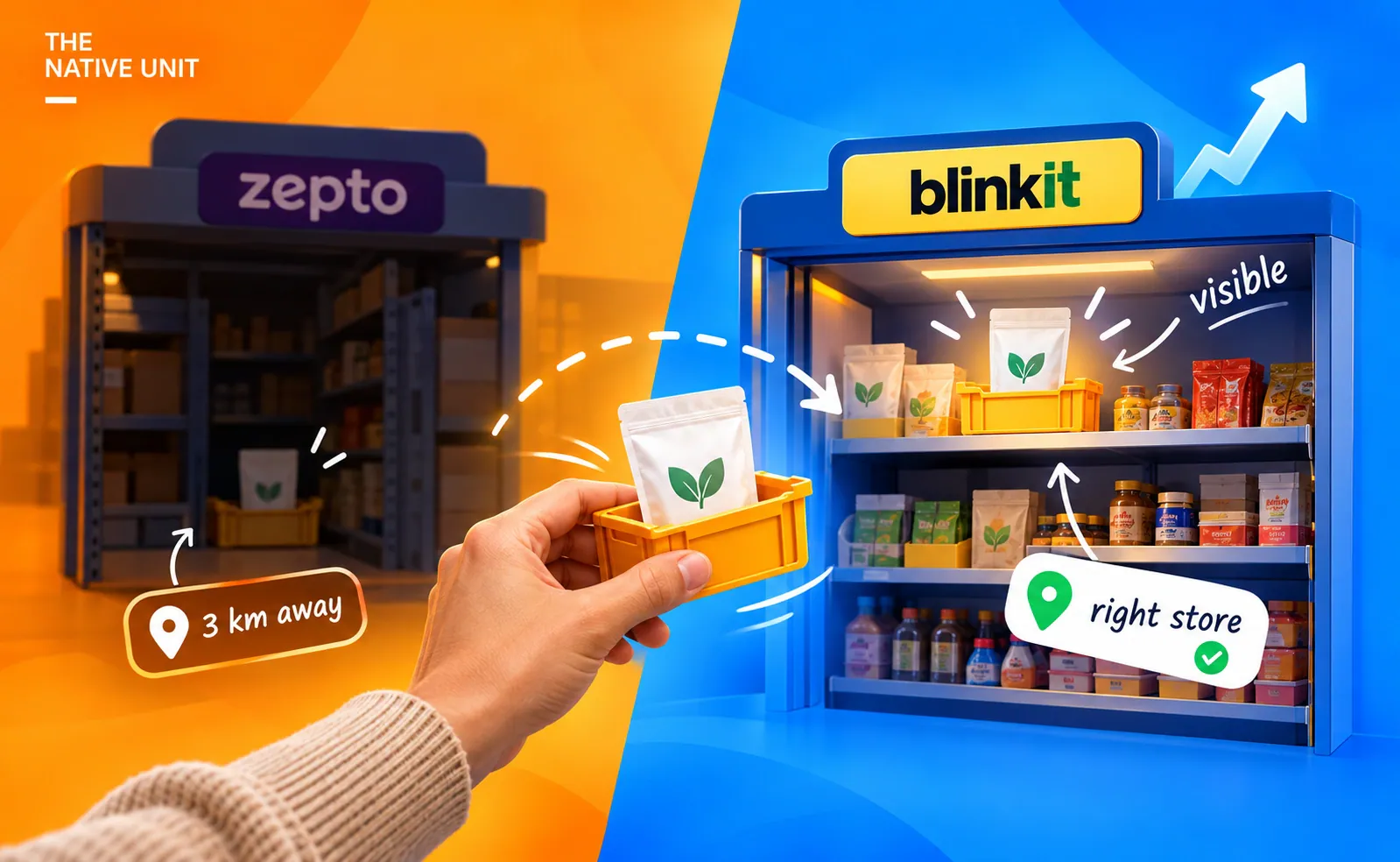
Ranking on Blinkit and Zepto has almost nothing to do with your product title, and everything to do with whether your stock is sitting in the right dark store when a shopper searches. Fill rate and sales velocity, tracked city by city, decide who shows up first, not keyword density.
A Brand Manager watching a D2C-first competitor own the Blinkit shelf in Bengaluru while her own SKU sits invisible three kilometres away isn't losing a content fight. She's losing an operations fight that marketing alone cannot win.
That gap is what NativeUnit calls the Q Commerce Visibility bottleneck, and it's the reason quick commerce keeps getting treated as a media-spend problem when it's actually a systems problem.
How to Rank Products on Blinkit and Zepto (definition) Ranking on Blinkit and Zepto is decided primarily by fill rate (how reliably a SKU stays in stock at a specific dark store) and sales velocity (how fast it sells once it's there), computed per store rather than nationally. A well-written listing cannot outrank a product that keeps going out of stock in a high-demand dark store. |
TL;DR
Rank on Blinkit and Zepto is hyperlocal: a product can top the category in one dark store and be invisible three kilometres away
Fill rate (stock reliability per store) and sales velocity (units sold per day per store) outrank keywords, images and titles
Dropping fill rate below roughly 90% at a store typically triggers algorithmic demotion at that store specifically
The usual fix (more ad spend) buys back visibility the catalogue and supply chain should have earned for free
A stockout doesn't pause your rank, it resets it, and the recovery window is where sponsored spend quietly creeps up
Quick commerce BPC GMV alone is growing roughly 90% YoY, so the cost of sitting invisible compounds faster every quarter
The fix is a named owner across catalogue, stock and sponsored spend, not a bigger media budget
Run the Visibility Debt Diagnostic below before your next budget conversation
See which SKU is costing you rank. |
The Real Reason Your Blinkit Rank Won't Move
Most teams treat a stalled Blinkit or Zepto listing the way they'd treat a stalled Amazon listing: rewrite the title, refresh the images, add a few keywords. On quick commerce, that fixes almost nothing.
Blinkit and Zepto compute rank per dark store, not nationally, because a dark store holds a few thousand SKUs and has to decide, in real time, what it can actually put on a bike in ten minutes. Fill rate, the share of time a SKU is in stock and orderable at a given store, is the metric that decides whether the algorithm even considers a listing for a top slot.
This is exactly the Q Commerce Visibility bottleneck: listings underperform not because they're poorly written, but because they don't sell fast enough or stay in stock reliably enough to earn the slot. According to Redseer's January 2026 read on the category, quick commerce GMV hit roughly ₹11,000 crore that month, growing close to 100% year on year, with dark store count climbing from about 5,990 to 6,280 in a single month. Every one of those new stores is a fresh local ranking battle a Brand Manager has to win from zero.
The Assumption That's Costing You Rank
The assumption most teams carry over from Amazon: ranking is a content problem, solved with better copy and a bigger ad budget. The reality on quick commerce is closer to the opposite.
Signal | Amazon / Flipkart marketplace | Blinkit / Zepto quick commerce |
Primary rank driver | Keyword relevance, review count, sales history | Fill rate and sales velocity, per dark store |
Geography | National rank | City and store-level rank, can differ block to block |
Recovery from a stockout | Listing stays live, rank dips slightly | Rank resets; algorithm treats it as a fresh product |
Where the ad budget compensates | Sponsored placement supplements a working listing | Sponsored placement papers over a broken supply signal |
The pattern we see across FMCG and personal care brands scaling past ₹20 crore: the marketing team owns the Blinkit listing, supply chain owns the dark-store replenishment schedule, and neither checks the other's number until sponsored spend has already crept up for a quarter. Nobody is wrong. Nobody owns the whole system.
How Fill Rate and Sales Velocity Actually Decide Your Rank
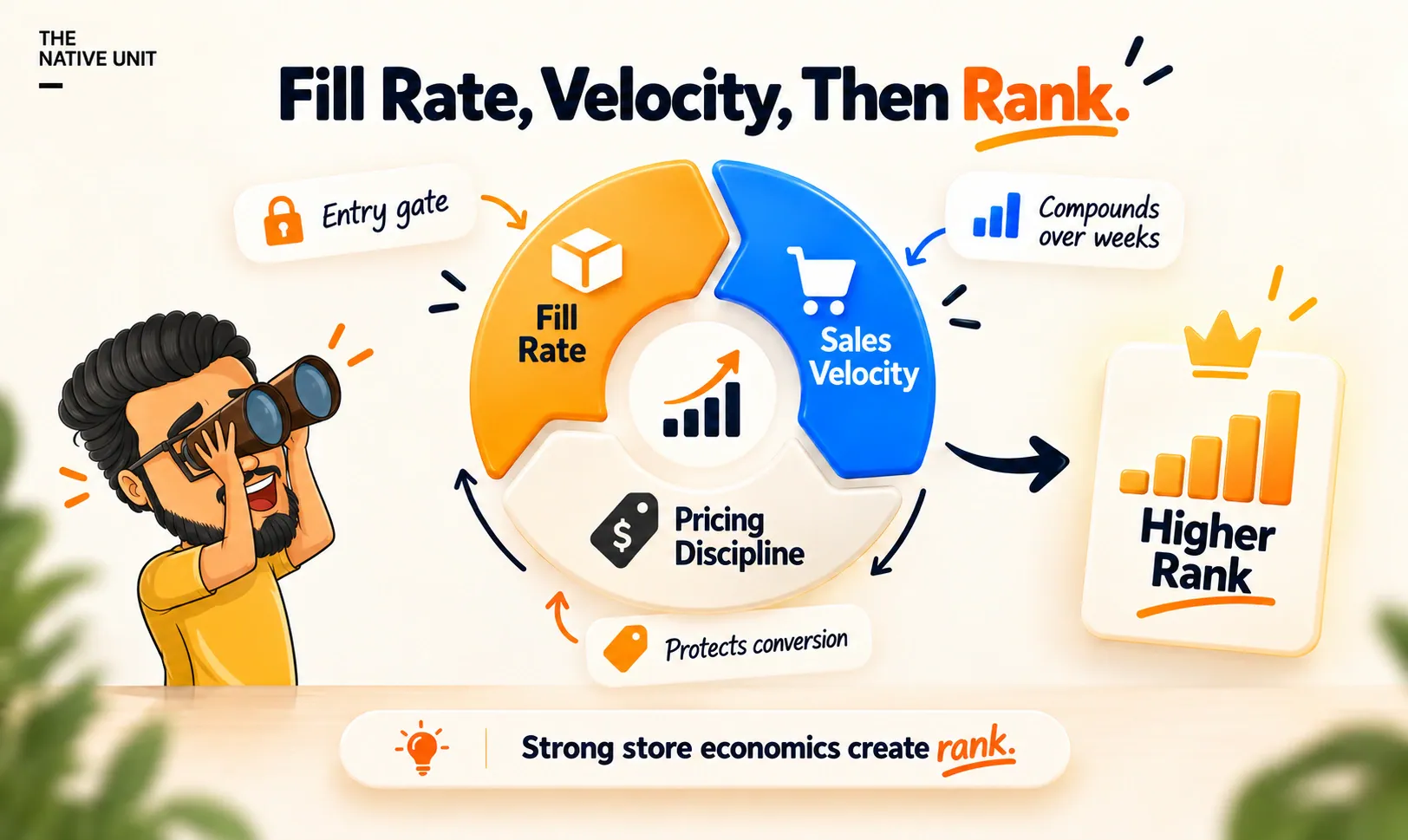
Three levers determine whether a SKU holds its slot, and they compound in this order:
Fill rate per store. Sellers widely report that once fill rate at a specific dark store drops to around 80-90%, that store's algorithm demotes the listing there specifically, regardless of how strong the listing looks elsewhere. This is the entry gate. Nothing else matters if this fails.
Sales velocity once stocked. Units sold per day in that store's delivery catchment is the strongest organic ranking signal once fill rate clears the bar. Early velocity in the first few weeks on shelf compounds into a durable rank advantage.
Assortment and pricing discipline. Pricing meaningfully above the category average quietly drags down conversion, which drags down velocity, which drags down rank, on a lag of weeks rather than days.
This is the Organic Growth Engine's job: making a SKU earn its slot through catalogue quality, stock discipline and pricing, rather than the Customer Acquisition Engine constantly buying the slot back through sponsored placement. When the Organic Growth Engine is broken, the Customer Acquisition Engine absorbs the cost silently, which is exactly the same CAC creep we've mapped out in how D2C brands actually reduce CAC without cutting growth.
Find out which of the three levers is costing you rank. Fix My System: get the audit that names which of the three levers is costing you rank → |
The India-Native Layer: Dark Stores, Festivals and the Tier-2 Push
Three things make this a distinctly Indian operating problem, not a generic marketplace one.
Dark-store density is exploding city by city. New stores mean new, unranked battles for every SKU, every month, not a one-time setup task.
Festival demand spikes strain fill rate hardest exactly when velocity matters most. A hero SKU that goes out of stock during a Diwali surge doesn't just lose that week's sales, it resets rank heading into the highest-intent weeks of the year.
WhatsApp catalogue nudges are becoming the workaround, not the fix. Some brands now ping loyal customers on WhatsApp when a hero SKU is briefly out of stock in their pincode, to hold the sale. It protects revenue for a day. It does nothing for the store's algorithmic rank.
📊 BPC quick commerce GMV is growing ~90% YoY India's beauty and personal care brands crossed roughly $1 billion in annualised quick commerce GMV as of early 2026, with quick commerce's share of online BPC projected to rise from 18% today to 27-31% by FY31. For a Brand Manager in this category, sitting unranked isn't a static loss, it's a compounding one. *Source: Redseer* |
The Visibility Debt Diagnostic
Here's the reframe worth screenshotting: a stockout doesn't pause your rank, it resets it, and the sponsored spend you use to recover is debt service on a debt your own operations created.
Run this in under five minutes:
Step 1. Pull fill rate for your top 5 SKUs across your 3 highest-volume dark stores over the last 7 days, from your seller dashboard.
Step 2. Flag any SKU that dipped below roughly 90% fill rate at any single store in that window.
Step 3. Check sponsored spend on those exact SKUs over the same window. If it rose while fill rate dropped, that increase is visibility debt service, not growth spend.
Step 4. Put a number on it. Say a hero SKU normally moves 40 units a day in a priority cluster, goes out of stock for 18 hours in a week, and takes roughly ten days to recover organic rank once restocked.
Recovering the lost velocity through sponsored clicks at ₹18 CPC and a 6% conversion rate on that placement costs roughly 150 units ÷ 6% × ₹18 ≈ ₹45,000, for one SKU, one stockout, one dark-store cluster. Substitute your own fill rate, CPC and conversion numbers; the shape of the debt holds regardless of the exact figures.
That number is usually the fastest way to get supply chain and marketing into the same room.
What Good Looks Like
| Visibility debt (unmanaged) | System in place |
Fill rate ownership | Checked monthly, nationally | Tracked daily, per dark store |
Sponsored spend | Rises quietly to compensate for stockouts | Used briefly to seed velocity, then steps back |
Rank after a stockout | Resets, recovered slowly at ad cost | Protected by fill-rate alerts before it drops |
Who owns the number | No one, split across two teams | One accountable system |
Quick commerce sessions run under five minutes against more than ten for typical e-retail, yet convert roughly eight times more often once a shopper actually finds the product, according to Bain & Company's 2026 India e-retail report. A brand that fixes fill rate and velocity isn't chasing a marginal gain. It's fixing the one channel where the conversion math already favours it, once it's actually visible. A shopper who finds the same product reliably in stock, order after order, also behaves a lot like the repeat-purchase pattern we've broken down in D2C retention versus acquisition economics.
⚠️ Warning Cutting sponsored spend the moment fill rate improves kills the flywheel before it seeds organic rank. Velocity needs a few consistent weeks to compound before the algorithm treats the SKU as reliably rankable. Step spend down deliberately, not all at once. |
When This Isn't Your Problem Yet
Quick commerce visibility work only pays off once a brand has real distribution to protect. If a SKU isn't live in enough dark stores yet to generate meaningful order volume, or if fill rate is failing because of a manufacturing or logistics constraint rather than a demand-planning one, no amount of listing or system work fixes that first.
Fix the supply constraint, then fix visibility. Sequencing this backwards just means paying sponsored rates to protect a rank that has nothing underneath it yet.
The System, Not the Spend
Quick commerce rank was never really about the listing. It's about whether fill rate, sales velocity and sponsored spend have one accountable owner, or three disconnected ones quietly working against each other.
The Organic Growth Engine is what closes that gap, by turning catalogue quality and stock discipline into a system the Customer Acquisition Engine no longer has to subsidise every month.
Own the system, not just the spend. Build the Q Commerce Visibility system your Blinkit and Zepto rank actually depends on → |
Frequently Asked Questions
Listing requires onboarding through each platform's seller programme, which involves catalogue setup (accurate MRP, net weight, batch and FSSAI details for food categories), compliant images, and category mapping. Onboarding typically takes four to eight weeks from application to a live listing.