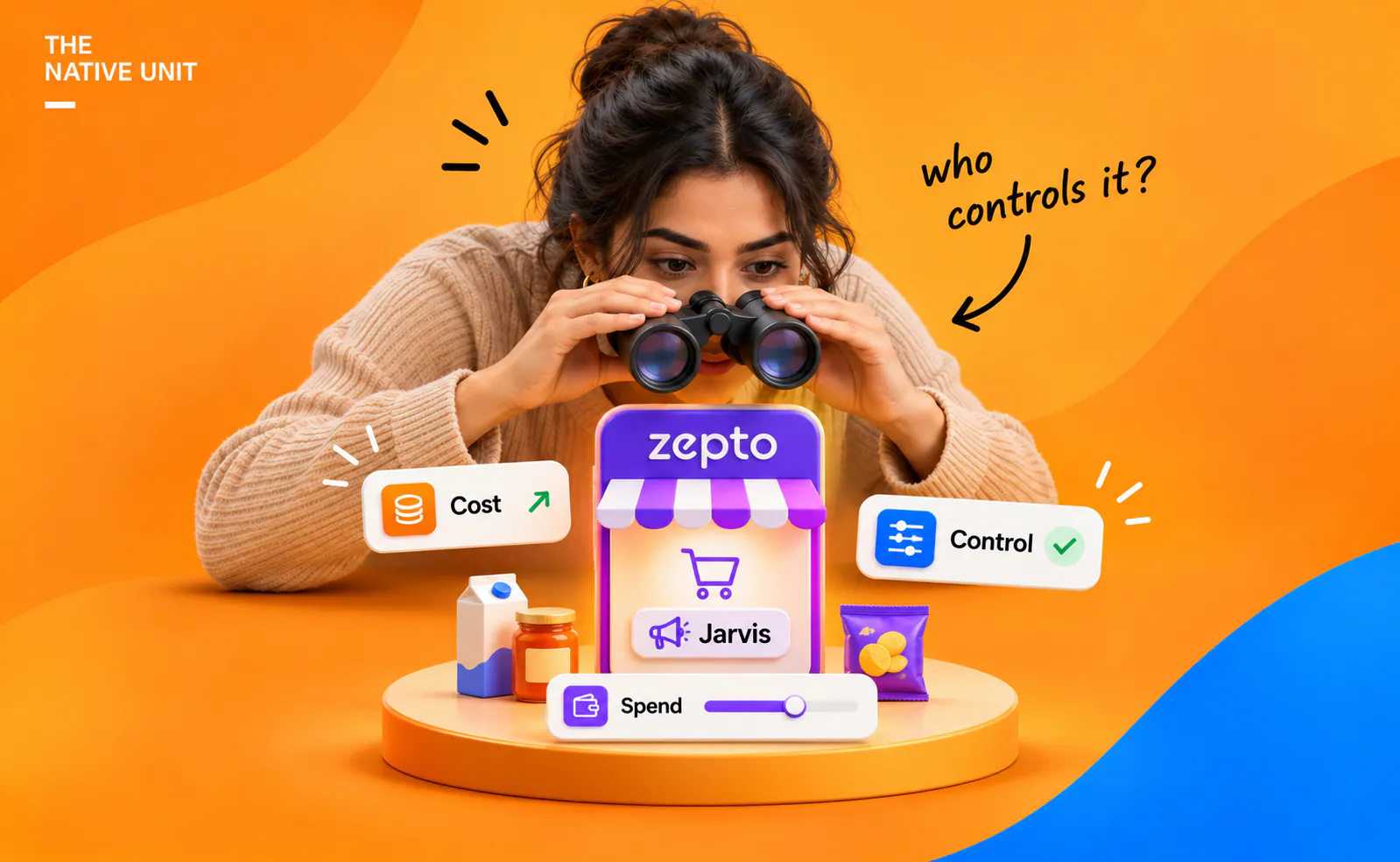
Zepto sells ads to brands through Jarvis, its in-house advertising platform. Formats run from sponsored listings in search to banners, video and push messages. A brand pays Zepto to appear where its shopper is already deciding, and Zepto also reports the result.
A Growth Head at a packaged food or personal care brand usually asks about cost first. The sharper question is who controls the spend.
Advertising was 7.2% of Zepto's FY26 operating revenue, according to Inc42's August 2026 analysis of its filings. The seller of your ads has a stake in how much you buy.
This is a Q Commerce Visibility problem, and it sits across two engines. The Customer Acquisition Engine owns what you spend. The Analytics & ROI Engine owns whether the number is true.
NativeUnit treats a Zepto budget as one input to a larger system, and that system must show contribution after returns.
Below: what Jarvis sells, how onboarding works, why rate cards mislead, and a four-gate check to run before any campaign goes live.
Zepto Ads (definition) Zepto ads are paid placements sold to brands inside the Zepto app through Jarvis, the platform Zepto announced in November 2024. They include sponsored listings in search and category pages, banners, video and push messages, bought by click, impression or another model depending on the format. Zepto sells the placement and reports the result, so a brand needs its own read on what the spend returned. |
TL;DR
Zepto sells brand ads through Jarvis, its in-house platform announced in November 2024.
Formats run from sponsored listings to banners, video and push, plus sampling and events on the partner page.
Onboarding comes first. Zepto says approved brands onboard in about 15 business days, and up to 45 in major sale periods.
Public rate guides disagree with each other, so get today's price in writing and read it as a share of order value.
The Four Gates check asks who starts, caps, reads and stops your spend.
A reported return is not an incremental return, because shoppers who searched your brand often buy anyway.
Spend only when listing, stock and rank are stable, and when you can answer all four gates.
Book a 10-minute audit and find which channel number is hiding your margin → |
Does Zepto Have Ads? What a Brand Can Buy Through Jarvis
Yes, Zepto sells ads to brands and sellers through Jarvis, an in-house platform announced in November 2024. Zepto says Jarvis spans awareness to conversion and had served over 15 billion ad impressions by launch. Brands run campaigns on the Zepto Ads Platform.
Zepto's partner page lists four levers for brands: ads, pricing, events and sampling. Pricing is set by the brand, events target high-demand periods, and sampling targets communities. Most guides skip the last three, yet a sampling slot can answer a trial problem that no ad can.
Operators who run several shelves see the same pattern. The ad console becomes the dashboard, and the platform selling the placement owns the console.
Source: Storyboard18 on the Jarvis launch, November 2024 and Zepto's partner page
Which Zepto Ad Format Fits Your Stage
Format | What it does | Brand stage it fits | Check before buying |
Sponsored listings | Lifts a product in search and category results by keyword or auto-targeting | Live SKU with stable stock | Which keywords match, and whether your own brand name is included |
Banners | Display slots on the home screen, category pages and search | Launch or sale-event push | Placement, city and the buying model |
Video and dynamic widgets | Rich units for mobile discovery | A product that needs explaining | Whether the report shows orders or only views |
Push and off-app messages | Reaches shoppers by past behaviour or co-brand promotion | Reactivation or an event | Who owns the audience data and the frequency |
Sampling and events | Trial and high-demand periods, per the partner page | New product or new city | Cost per trial buyer, and what happens after |
Sources: Zepto's partner page for sampling and events. The other rows come from agency guides and Google's AI Overview, so confirm the live menu in your account. Zepto does not publish a full format list.
Match format to stage, not to budget. A new listing with thin reviews needs sponsored listings on its own search terms first. Banners and video earn their place after conversion is proven.
Getting Onboarded: The Steps Before Any Ad Can Run
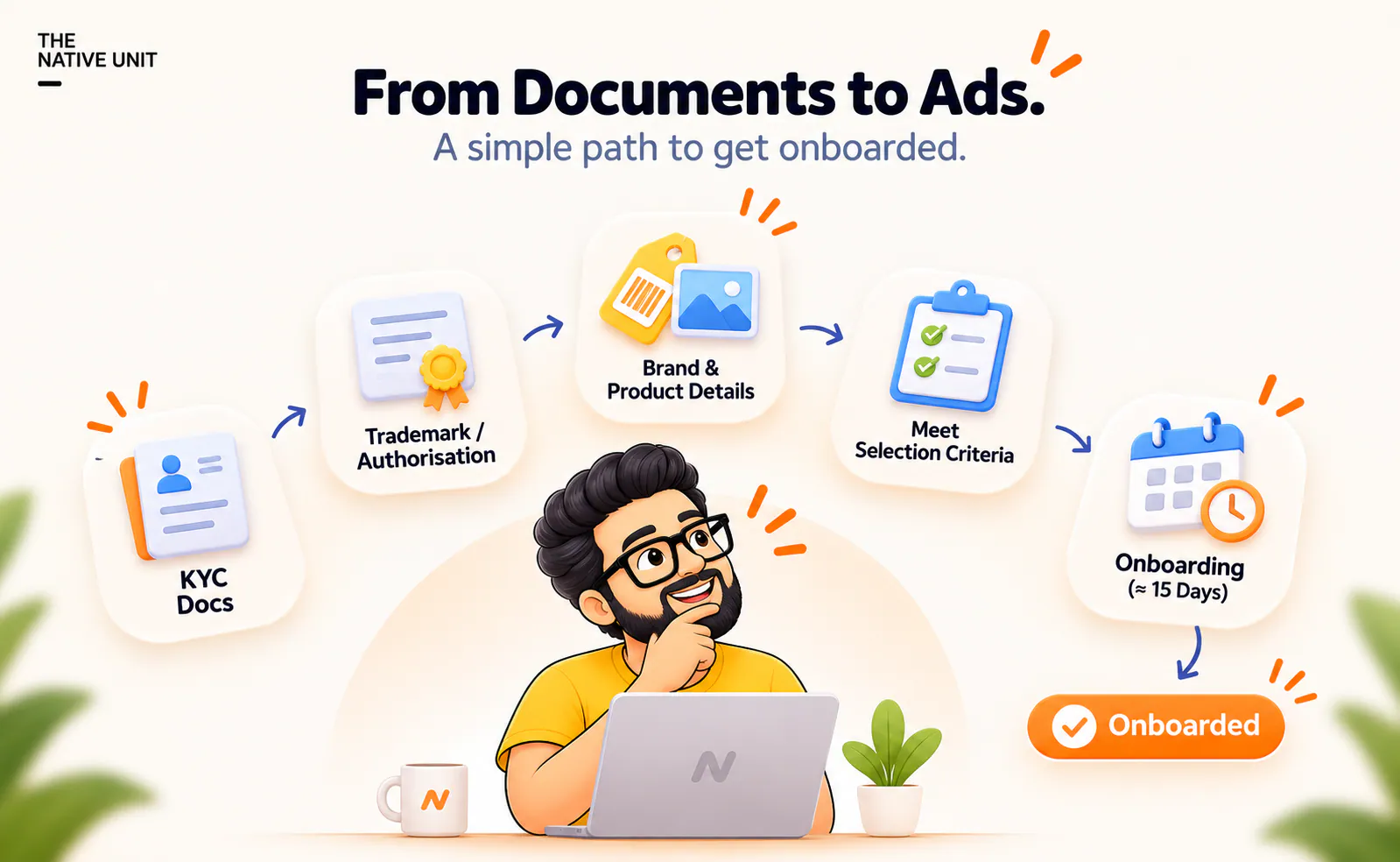
Ads run only after a brand is listed, and listing has its own queue. Zepto's partner page sets out the steps:
Apply through the partner page with your PAN, GSTIN certificate, cancelled cheque and an authorised signatory's signature copy.
Provide the original trademark certificate, or an authorisation letter or NOC on the brand owner's letterhead.
Supply brand tag details, accurate product sizing and article images that meet Zepto's cataloguing specifications.
Qualify on selection criteria. Zepto says it looks for a sizeable catalogue width and a quality product with a unique value proposition.
Wait. Zepto says onboarding takes up to 15 business days, and up to 45 during major sale events.
A Brand Manager planning a festive push should start the application early, because the sale-event queue is the longest. Organic rank still decides what an ad amplifies, and how to rank products on Blinkit and Zepto covers what to fix before spend begins.
What Zepto Ads Cost, and Why a Rate Card Will Not Settle It
Zepto's public partner page shows no rate card. Agency guides fill the gap, and they disagree. One guide lists a base rate and a different offer rate for the same format, plus two different minimum spends.
Formats are reportedly bought by click for listings and by impression for banners and video, but treat that as vendor-reported. Ask your account manager for the live price and the buying model in writing. Then convert it, because the number that matters is ad cost per order as a share of order value.
📊 More than 4% of sales Zepto said its ad income was above 4% of sales at launch, against a 3% to 3.5% quick commerce benchmark from BofA Global Research. The platform's own economics push it to sell ads. Source: Storyboard18 |
The Four Gates of Zepto Spend: Who Starts, Caps, Reads and Stops Your Ads
In June 2025, Storyboard18 reported, citing Moneycontrol, that Zepto told brand partners it had auto-activated campaigns on accounts with none running. The report said this could let Zepto debit pre-approved budgets or ad wallets. Brands said the note named no default budget, bidding or targeting, and that opting out reportedly needed an account manager.
We cannot confirm whether that default applies to your account today. That is the reason to check. The Four Gates give a Marketing Director a ten-minute test of spend control:
Gate | Question | Pass looks like | Fail looks like |
1. Start | Can any campaign begin without your written approval? | Every live campaign was created or approved by you | Auto or account-manager campaigns you did not see |
2. Cap | Is there a hard daily and total cap, and how does the wallet refill? | You set the cap, and top-ups need your action | The wallet refills or debits without a fresh approval |
3. Read | Can you match Zepto's reported sales to your own order and settlement data? | The attribution window is written down and orders reconcile | You see only the platform's report |
4. Stop | Can you pause or exit every campaign yourself, the same day? | Self-serve pause on every campaign | Exit needs an account manager and a reason |
Score one point per pass. Four means scale carefully, two or three means fix the failing gates before raising spend, and zero or one means freeze new spend.
⚠️ Warning Never add budget to a campaign that fails Gate 1 or Gate 4. Money you cannot stop is not a test, and a result you cannot read is not evidence. |
The pattern that costs most is a campaign nobody on the brand side remembers approving. Get the answers to all four gates in writing from your account manager, and keep the reply.
Why a Reported Return Overstates What Zepto Ads Earn You
Zepto says well-optimised Jarvis campaigns can return up to 8x on ad spend. That is a ceiling claimed by the seller of the ad, not a benchmark. Your own number will sit below it.
The gap comes from shoppers who would have bought anyway. A shopper who searches your brand name on Zepto and clicks your sponsored listing is counted as an ad sale. This worked example uses illustrative index numbers per 100 of attributed sales:
Line | Per 100 of attributed sales |
Attributed sales, reported return of 4.0 | 100 |
Ad cost (100 divided by 4.0) | 25 |
Contribution before ads, at 30% of sales | 30 |
Apparent result after ads | +5 |
Sales that would have happened anyway | 40 |
Incremental sales | 60 |
Contribution on incremental sales | 18 |
True result after ads | -7 |
The same shopper mix at a reported return of 8.0 gives +5.5. The break-even reported return is 100 divided by 18, or 5.6. Substitute your own contribution margin and your own share of shoppers who searched your brand.
Measurement is improving. In June 2025, The Trade Desk and Zepto announced closed-loop measurement for brands that buy through The Trade Desk. Whether it helps you depends on how you buy.
Treat audience counts with care too. Zepto's partner page cites 47M+ active customers, and the 2025 announcement cites over 60 million monthly active users. Ask which base your reach numbers use.
Your First 30 Days on Zepto Ads, in Order
Days 1 to 3: run the Four Gates and get the answers in writing.
Days 4 to 10: confirm the listing, stock and rank are stable. Where an ad wallet is prefunded, size the cash it locks using the quick commerce payment terms guide.
Days 11 to 17: run one sponsored-listing campaign on one proven SKU at a capped budget.
Days 18 to 24: compare Zepto's reported orders with your own order and settlement data. Work out your break-even reported return.
Days 25 to 30: add a second SKU or a banner only if all four gates pass and the true result is positive.
The same discipline applies to the ROAS you see elsewhere. Improving ROAS for D2C brands explains why the figure in an ad console rarely matches the figure in the bank.
Want One Owner for the Number Across Zepto, Blinkit and Your Own Site?
Most brands read one report per platform and an agency deck on top. None of them shows a single contribution line after returns. The Analytics & ROI Engine at NativeUnit is built around that one line.
Fix My System: see your Zepto, Blinkit and own-site numbers as one contribution line → |
When Zepto Ads Are Not Your Problem
If your listing is not approved or live, ads have nothing to promote. If stock runs out in the cities you target, spend buys clicks that cannot convert. If contribution after platform margin is already negative, ads add cost to a loss.
A COO or Ops Head should also pause if nobody can reconcile even organic Zepto orders to settlements. Fix that first. A channel you cannot read cannot be scaled.
Conclusion
A Zepto ad budget is a control problem before it is a cost problem. The platform sells the placement, has reportedly started campaigns on idle accounts, and reports the result. Closing the Four Gates puts the brand back in charge of what it spends and what it believes.
When the gates pass, the Customer Acquisition Engine decides where spend goes and the Analytics & ROI Engine decides whether the number is true. Build My Growth Stack with one accountable owner for the number. Before you fund a campaign, read how to rank products on Blinkit and Zepto so the ad amplifies a listing worth amplifying.
Frequently Asked Questions
Apply through Zepto's partner page with your PAN, GSTIN certificate, cancelled cheque, signatory signature copy and a trademark certificate or authorisation letter. Zepto also asks for brand tag details, product sizing and article images that meet its cataloguing specifications. It says approved brands onboard within 15 business days, and up to 45 days during major sale events. Selection depends on catalogue width and product quality.