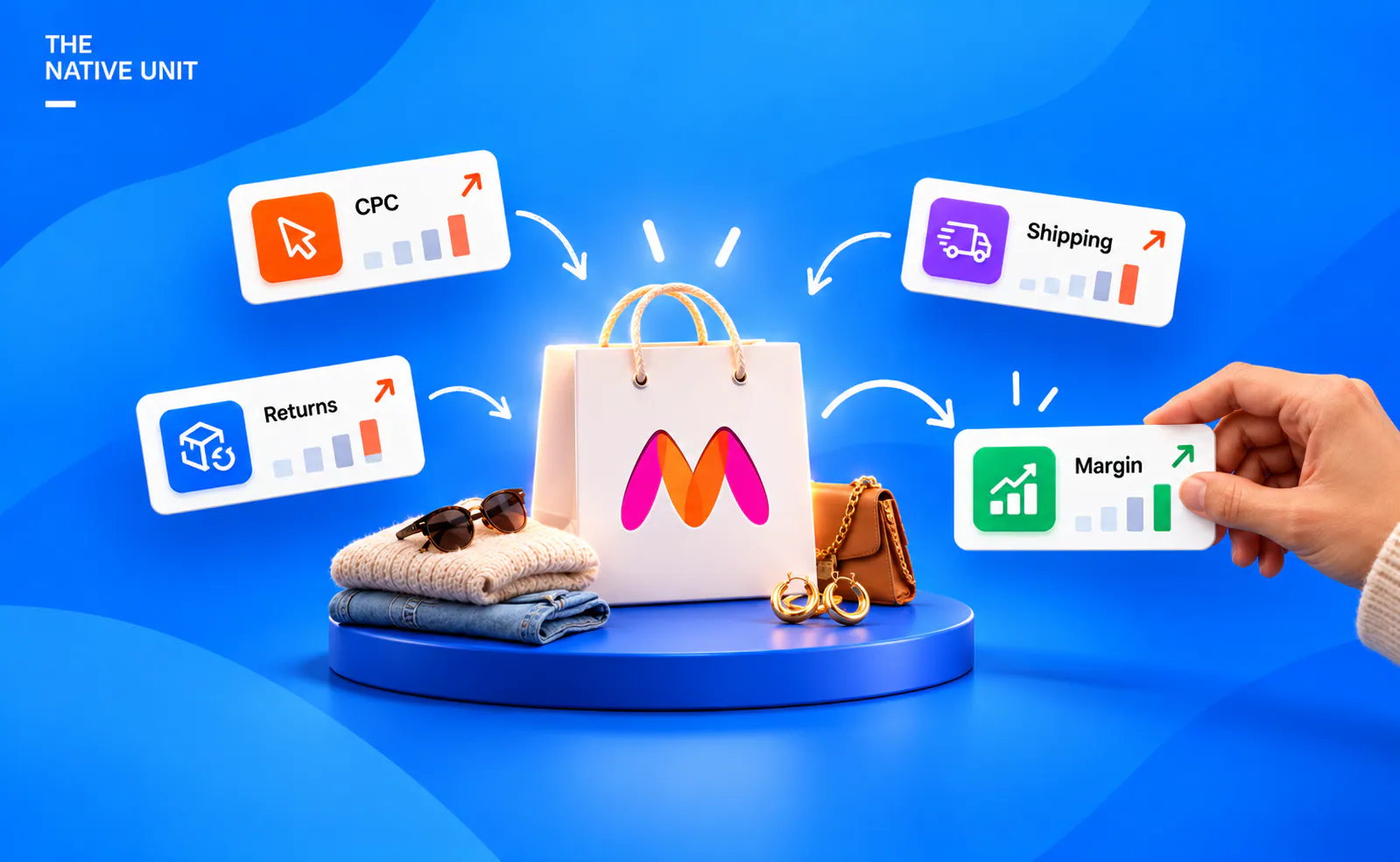
Myntra Ads is the self-serve advertising console in Myntra's partner portal. Most of what a brand pays through it is a cost-per-click auction for sponsored product slots. Myntra does not publish click prices, so your real cost is whatever your styles win at, judged against what a kept order earns you.
A Founder or Marketing Director at a fashion or fashion-jewellery brand sees one number in the console, and finance sees another after returns. That is the No Unified Dashboard bottleneck. Performance sits in the Myntra portal, the returns report and your own site, so nobody sees the margin on an ad-sold order.
The stakes rose in 2026. Myntra's advertising income grew 35.2% to ₹1,236.4 crore in FY26, according to Indian Retailer's report on Myntra's FY26 results. More brands are bidding for the same slots.
NativeUnit's Customer Acquisition Engine runs paid ads, and its Analytics & ROI Engine reads margin after returns. This guide covers the ad formats, setup order and Growth Enablement Charge. It also gives a bid ceiling to compute first, and a test for when to hire help.
Short answer: how do Myntra ads work, what do they cost, and when should a brand hire help? Myntra Ads sells sponsored product placements by cost per click, set by auction, and Myntra publishes no click price. Work out a bid ceiling from your kept-order contribution before you accept any suggested bid. Hire help only when someone must read margin across Myntra and your other channels every week. |
TL;DR
Myntra's partner portal lists Product List Ads, Display Ads, Search Banners and M-Live, and Myntra publishes no public rate card for them.
Product List Ads are the self-serve format, and sellers pay when a shopper clicks.
Third-party guides describe a one-time Growth Enablement Charge for new sellers, returned as ad credits, and they disagree on the credit value.
A platform RoAS counts orders, while your margin depends on kept orders.
The Bid Ceiling is conversion rate times the contribution you keep per ordered order, and any bid above it loses money.
In the worked example, a ₹1,299 kurta set tops out near ₹6.63 a click and a ₹699 jewellery set near ₹3.70.
Myntra's ad income grew 35.2% in FY26, so slots are getting more contested.
Next step: write the ceiling for your top ten styles before you set a bid or hire anyone.
Book the 10-minute audit and bring your top ten Myntra styles → |
What Myntra Ads Include and What Myntra Does Not Publish
Start with Product List Ads. They are the only format a brand can open on its own and test with a small budget. The other formats are bought through Myntra's team.
Format | Where it shows | How it is bought | Use it when |
Product List Ads (PLA) | Myntra's own portal tutorials name Top of Search, Top of Home and Product Detail Page | Self-serve in the portal, paid per click | Styles already convert and you want more of that traffic |
Display Ads and Search Banners | Named on Myntra's partner portal page | Through Myntra, with no public rate card we could find | A launch or sale peak, once PLA already pays back |
M-Live and other formats | Named on the same page, with no public detail | Ask your category manager | Only if offered, with measurement agreed in writing |
According to Unicommerce's Myntra seller guide, sellers pay for a Product List Ad only when a consumer clicks on the product. The same guide notes a zero-commission model for an initial period and does not state its length.
📊 ₹1,236.4 crore of advertising income in FY26 That is up 35.2% from ₹914.5 crore, and about 24% of Myntra's ₹5,242.5 crore operating revenue by our arithmetic. For a Brand Manager, the slots you bid on are a growing part of how Myntra earns. Source: Indian Retailer |
Myntra also told the same outlet it is on track to reach 100 million monthly active users this festive season. Traffic is growing, and so is the number of brands competing for it.
How to Run Ads on Myntra: Setup in the Order That Protects Margin
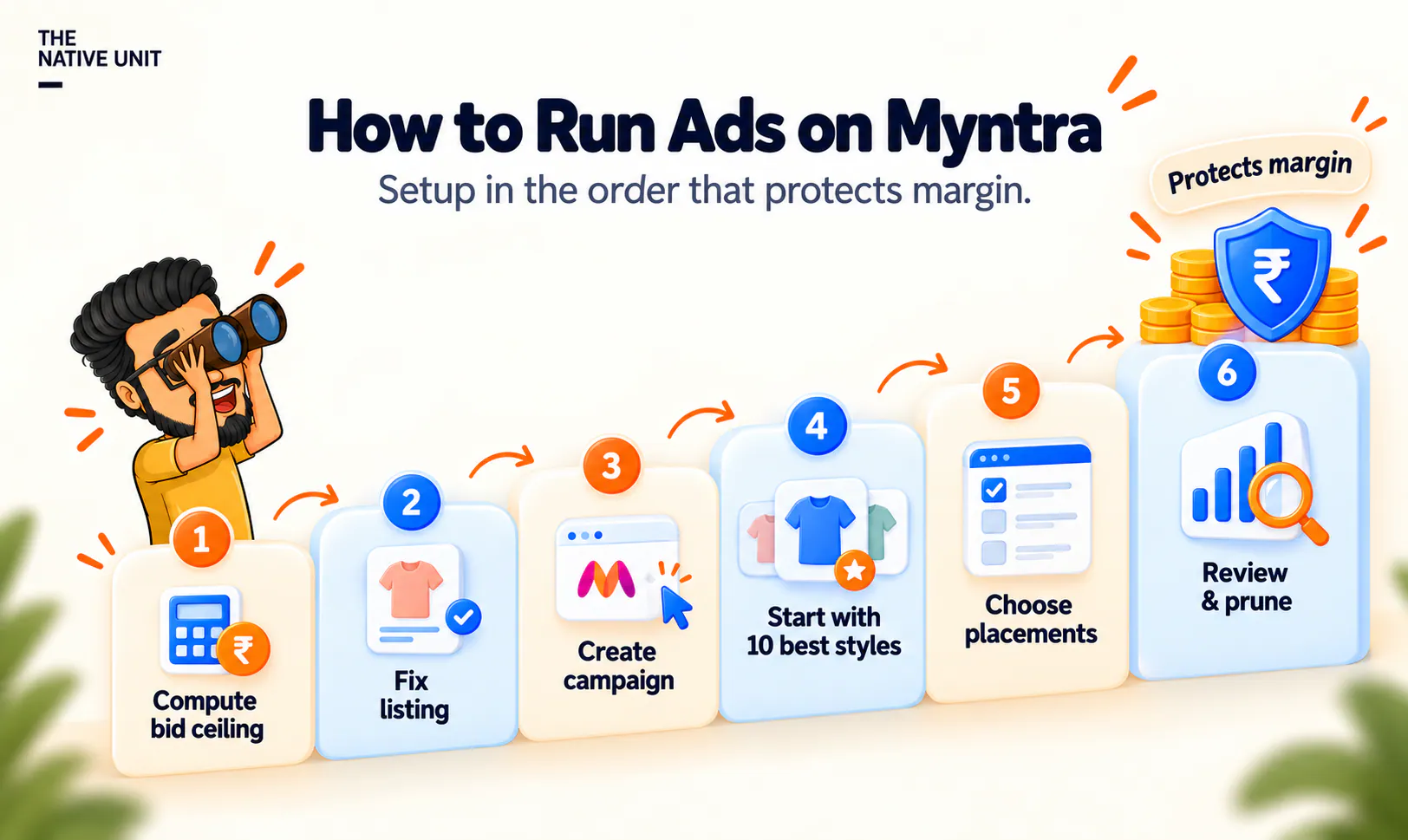
Log in to the Myntra Ads portal, create a Product List Ad campaign, and set its duration, budget and daily limit. Then build ad groups of styles and keywords, and review reports weekly. Work out your bid ceiling first, because it decides every later setting.
A Brand Manager running this for the first time should follow the order below.
Compute the Bid Ceiling per style. The next section shows the formula. Skip this and every bid is a guess.
Fix the listing. Images, a complete size chart, accurate attributes and stock at every size decide the sale, not the ad.
Create the campaign. Myntra's portal tutorials walk through setting the duration, the budget, ad groups and daily limits.
Start with your ten best-converting styles. Ten styles with a real budget teach you more than a whole catalogue with crumbs.
Choose where to appear. Myntra's tutorials name Top of Search, Top of Home and Product Detail Page. Start with search, where the shopper has typed a need.
Review weekly and prune. The portal lets you filter campaigns by status, edit budgets, modify style IDs and update keywords. Cut styles that sit above their ceiling.
The Growth Enablement Charge: Ad Budget You Have Already Paid
Several seller guides say Myntra charges no registration fee, but new sellers pay a one-time Growth Enablement Charge. Those guides describe it as ₹15,000 or ₹25,000, netted off your payouts and returned as ad credits. We could not find Myntra's policy on an open page, so treat every figure as second-hand.
The guides also disagree. One reads the credit as equal to the charge, and another lists ₹30,000 of credits for ₹15,000 and ₹50,000 for ₹25,000, valid for six months. A Founder should confirm the tier, the credit value and the expiry in the partner portal before planning anything.
Treat the credit as a budget you are forced to commit, not as a fee. A COO or Ops Head should also book it as marketing spend that is recovered from payouts, so cash reads correctly in the first months.
The practical use is a two-week test on your best styles with a pass line set by the Bid Ceiling. Several guides also describe an optional assisted programme where Myntra's team runs the credits, at no extra cost. If you use it, take the keyword and style data back afterwards.
Why Platform RoAS Overstates a Fashion Order
The assumption is that a Myntra ad is working when the console shows a RoAS above your target. The reality is that a console counts orders, and your P&L counts kept orders.
Fashion is the category where the two diverge. A kurta set bought in two sizes comes back in one. A jewellery order comes back when the finish is not what the photo showed. Ask your category manager whether attributed revenue in your reports is net of returns, and assume it is not until they say so in writing.
The pattern we see in fashion brands moving onto marketplaces is that the first ad report is read in days. The returns arrive weeks later, so money is spent on the early number and judged on the late one.
⚠️ Warning A campaign judged on day three has not met its returns yet. Wait for the return window on those styles to close before you scale a campaign or call it a loss. |
A kurta brand at ₹1,299 and a fashion jewellery brand at ₹699 use the same console and face different maths. The next section shows how different.
The Bid Ceiling: The Click Price You Can Afford Before You Open the Console
Myntra shows a suggested bid and publishes no price list, so the only click price that matters is the one your margin can pay. The Bid Ceiling is that number. It is the most you can pay per click and still break even on kept orders.
Bid Ceiling = conversion rate × (kept share × contribution per kept order − returned share × cost per return)
|
Contribution per kept order is price minus product cost, Myntra's commission and fees, packaging and outbound shipping, before ads. Cost per return covers reverse shipping and any unsellable stock. The inputs below are illustrative, so substitute your own.
| Kurta set | Fashion jewellery set |
Price | ₹1,299 | ₹699 |
Contribution per kept order, before ads | ₹380 | ₹210 |
Return rate | 30% | 20% |
Cost per returned order | ₹150 | ₹100 |
Conversion rate (click to order) | 3% | 2.5% |
Net contribution per order placed | ₹221 | ₹148 |
Bid Ceiling per click | ₹6.63 | ₹3.70 |
Break-even platform RoAS | 5.9x | 4.7x |
For the kurta set, 70% of orders are kept and earn ₹380 each, which is ₹266. The 30% that come back cost ₹150 each, which is ₹45. That leaves ₹221 per order placed, and 3% of clicks become orders, so each click is worth ₹6.63.
Break-even RoAS is price divided by that net figure, so a kurta brand needs about 5.9x platform RoAS just to stand still. This is the break-even logic of the ROAS Four-Term Test with returns added, and it assumes conversion does not change with the bid.
Two things follow. A suggested bid above your ceiling is a loss you have agreed to before the first click. And a cheaper product does not mean a cheaper ceiling to accept, because the same click buys less contribution.
Visibility on Myntra Starts Before the Ad
Visibility on Myntra comes from the listing before the ad. That means sharp images, a complete size chart, accurate attributes and keywords, stock in every size and a price that compares well. Ads can buy a slot, but they cannot make a weak style convert. Fix listings first, then pay for traffic to styles that already sell.
Before you spend, check each style on four points:
Organic click and conversion. A style that does not convert on free traffic will not convert on a paid click.
Size coverage. A sponsored style with sold-out sizes pays for clicks it cannot fulfil.
Images and size chart. In fashion, hesitation about fit is the main reason a shopper leaves.
Price against similar styles. Look at the first page of search for your keyword and place your price honestly.
Who Should Run Your Myntra Ads: In-House, Assisted or Specialist
A Marketing Director has three real options in 2026. WPP Media forecasts India's retail media ad revenue to grow 30%, so agencies and partner programmes selling marketplace ads are multiplying. Choose on who will own the margin, not on who offers the lowest fee.
In-house suits a brand where one person reads the portal weekly and knows each style's ceiling. The assisted programme suits a new seller with nobody to run campaigns, if you take the data back after month one. A specialist suits a brand where someone must own margin across Myntra, Amazon, Flipkart and your own site, because a single-marketplace partner optimises one console.
Before you sign with anyone, ask:
How are you paid? The answer should say what happens to the fee when spend rises.
Whose number is the ROI? Console RoAS and kept-order margin are different answers.
Which of my styles sit above their Bid Ceiling today? A partner that cannot answer has not read your fees.
Who owns the portal access, keywords and style data if we part? Get it in writing.
What do you report beside Myntra? The Second-Agency Problem starts when each partner reports only its own console.
A simple test for timing: compare the retainer with the monthly loss on styles above their ceiling. If you cannot name that loss, run the ceiling table first, and hire second.
Want One Owner for Margin Across Myntra and Your Other Channels?
For a Founder, running Myntra ads takes a portal login. Owning the blended number takes someone who reads contribution margin across Myntra, your marketplaces and your own site every week.
NativeUnit builds growth systems for D2C and FMCG brands. The Customer Acquisition Engine and the Analytics & ROI Engine exist for brands that run every channel with no one owning growth. Our published case studies do not describe Myntra advertising results, so we make no Myntra claim.
When You Should Not Spend on Myntra Ads Yet
Ads amplify a listing, good or bad. A Founder should be honest about which of these is the real situation:
You do not know contribution per kept order. Without it, no bid is good or bad.
The styles have weak images, thin size charts or broken size runs. You would pay for clicks that cannot convert.
You have not confirmed your Growth Enablement terms. Know the credit value and expiry before you plan around it.
You have fewer than a handful of styles live. A tiny catalogue gives you no search terms or style data to learn from.
Your real leak is acquisition cost across channels. Start with the CAC reduction playbook before buying marketplace clicks.
Conclusion
Myntra ads cost whatever your styles win at in an auction you cannot see. The number that protects you is the ceiling your kept-order margin sets. The Bid Ceiling, a clean listing and a wait for returns turn a dashboard into a decision.
No Unified Dashboard eases when one owner reads Myntra beside your other channels on margin. The Customer Acquisition Engine runs the ads, and the Analytics & ROI Engine owns the ceiling they are judged against.
Frequently Asked Questions
Myntra publishes no click prices, and Product List Ads are paid per click at auction. Banners and other managed formats are quoted by Myntra with no public rate card we could find. Your real cost is the click price your styles win at, judged against the Bid Ceiling for each style.