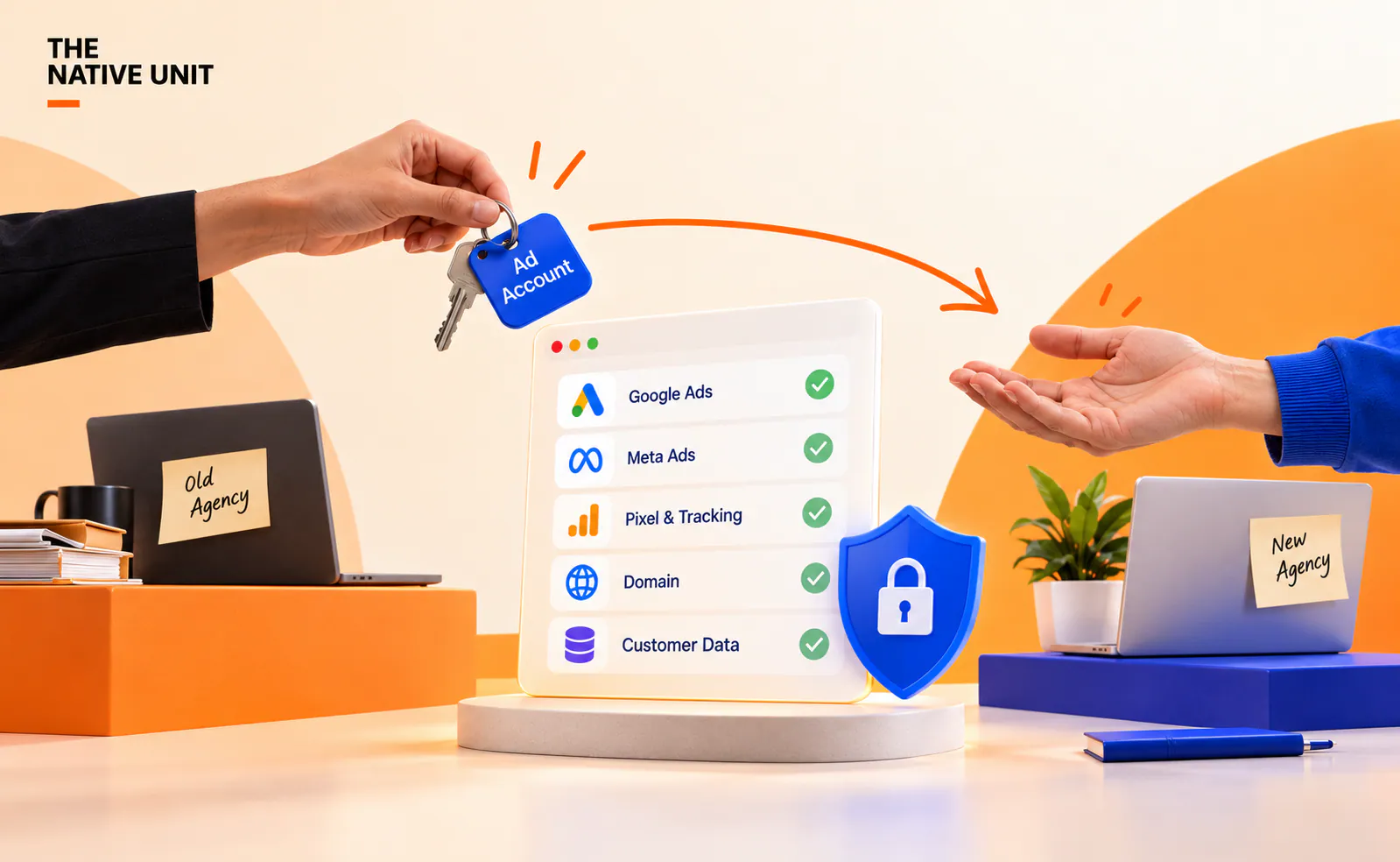
To switch marketing agencies without losing your ad account, confirm that your own business owns the ad account, pixel, domain and customer data. Then change who has access, not who owns the asset. Do this before you give notice, and keep the old and new agency overlapping for a few weeks.
A Founder or Marketing Director who has run ads through an agency for a year often cannot name who owns the ad account. That is the No Unified Dashboard bottleneck in its worst form: performance, tracking and customer data sit in tools the brand cannot open. Growth you cannot take with you is rented growth.
Agency moves are normal in India. COMvergence counted 62 media account moves and retentions worth about $838 million in the first half of 2026. Those are large mandates, but the mechanics at a D2C brand are the same.
NativeUnit's Analytics & ROI Engine keeps tracking and reporting in the brand's own hands, and the Customer Acquisition Engine runs the ads on top. This guide gives a ten-minute ownership test, a seven-step switch, the India-specific assets most checklists skip, and a way to price the risk.
Short answer: how can a D2C brand switch agencies without losing its ad account, pixel and history? Check ownership first. If the ad account, pixel and Page sit in your own portfolio, the new agency joins as a partner. The old one is removed last. If an agency owns them, you may have to rebuild, so find out before you give notice. |
TL;DR
Meta lets an agency use a client's ad account while the account stays in the client's portfolio.
Only the organisation that owns an asset can share it with another business, so ownership decides everything.
Pixels, audiences, catalogues and creative folders are data sources inside a portfolio, so they follow whoever owns it.
The Keys Test: open each asset with only your own login. Any asset that fails is held by someone else.
In the worked example, losing a pixel's history costs about ₹3.2 lakh of margin, on ₹10 lakh of monthly spend.
Overlap old and new agencies for two to four weeks, and remove the old partner last.
Do not switch in the weeks before Diwali on 8 November 2026. Fix ownership now and move in the new year.
Next step: run the Keys Test before you read the contract.
Do You Own Your Ad Account? The Ten-Minute Keys Test
Log out of everything, then open each asset below using only your own email and phone. If a login fails, someone else holds that asset. Do this before any conversation about notice.
Asset | What to check | Who can lock you out |
Meta ad account | Open your own business portfolio and look for the account in its ad accounts list. Meta says an account shared with an agency stays in the owner's portfolio | The agency, if the account is in its portfolio |
Pixel or dataset | Look under Data sources in your portfolio's settings. Meta lists datasets and pixels, catalogues, custom conversions, shared audiences and creative folders there | The agency, if it created the pixel |
Facebook Page and Instagram | Check that your portfolio has full control, not partial access | Anyone who is sole admin |
Google Ads | In the account, open Admin, then Access and security, then the Managers tab, to see which managers are linked | A manager account you do not control |
GA4, Tag Manager and Search Console | Confirm you hold the admin role | The person who created each property |
Store and domain | Confirm the store owner login and the domain registrar login are yours | The agency, if it registered either |
Marketplace and quick-commerce portals | Confirm Amazon, Flipkart or Blinkit logins are on your email | Whoever registered the seller account |
WhatsApp Business account | Ask which provider holds the number and the approved templates | The messaging provider or agency |
Email and CRM lists | Confirm you can export the full customer list yourself | The tool's account owner |
Billing | Confirm ad spend runs on your card or credit line | The agency, if spend is on its line |
Score one point for each asset you opened alone. A Marketing Director who scores all ten is facing a handover. Anything lower means the agency holds keys, and the first job is moving them.
Why Moving the Account Is the Wrong Fix
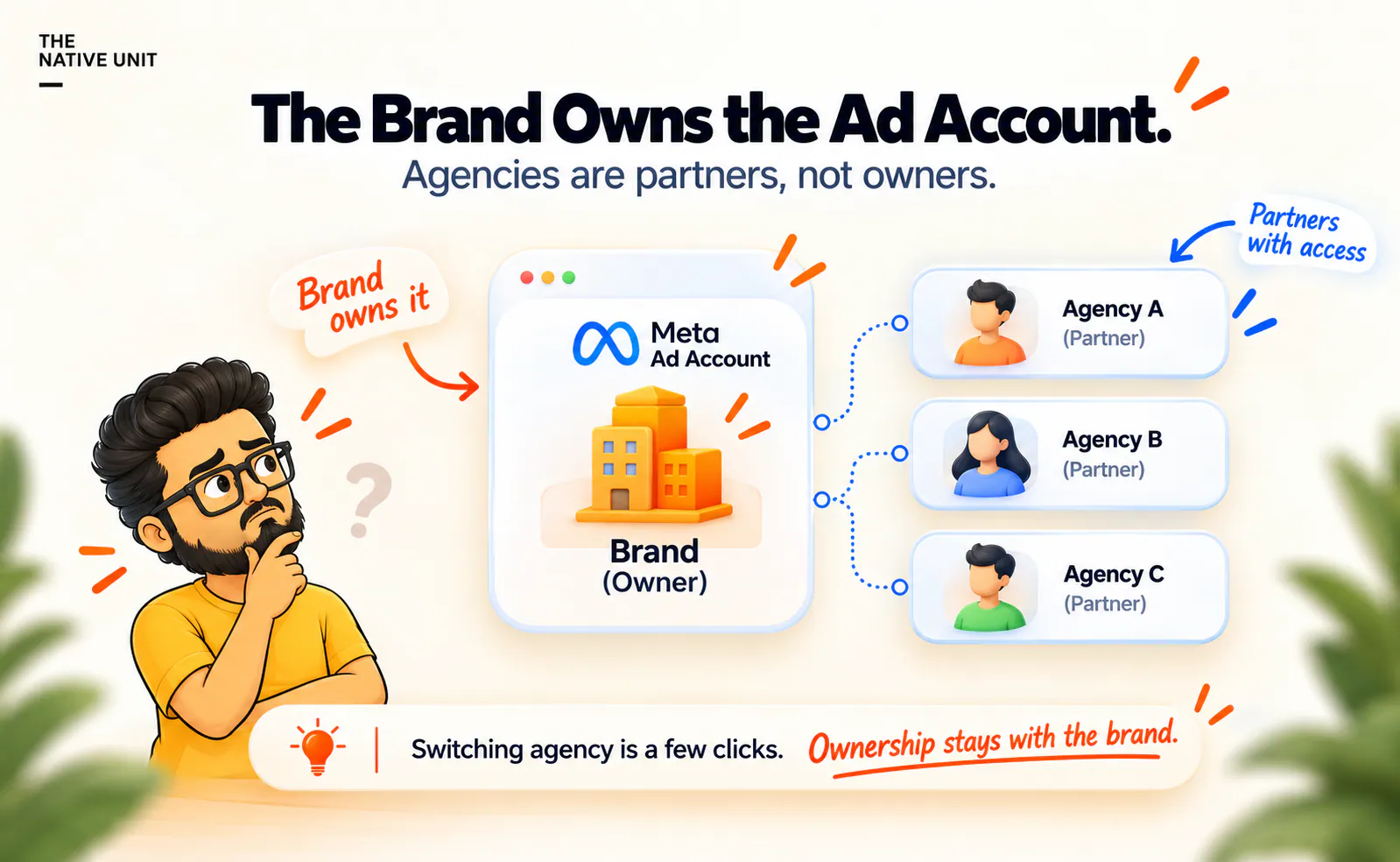
The assumption is that when an agency leaves, the ad account leaves with it or comes back to you. The reality is that Meta's rules route everything through the owning portfolio.
Meta's Business Help Centre gives three ways to add an ad account: create a new one, claim an existing one, or request to share one. Request to share is built for agencies, and the account remains in the client's portfolio. Meta also says a partner with full control cannot share an asset onward, because only the owning organisation can.
So the clean design is simple. The brand owns the account, and every agency is a partner with partial or full access. Switching then costs a few clicks. If the agency owns it, a leaver can take the keys, and a new account starts without the old one's tracking history.
💡 Tip for Founder teams Never let an agency create the ad account, pixel or Page in its own portfolio "to save time". Create them in your portfolio and give the agency partner access. It costs ten minutes now and saves a rebuild later. |
The Relearning Bill: What Losing the Pixel Costs
A lost pixel or ad account does not erase your customers. It resets what the platform has learned about them, and performance usually dips until it rebuilds. We found no published standard dip, so the figures below are assumptions you should replace.
Input | Example |
Monthly ad spend | ₹10 lakh |
ROAS on the old account | 3.0x |
ROAS on the new account while it relearns | 2.2x |
Weeks of dip | 4 |
Contribution margin on revenue, before ads | 40% |
Revenue falls from ₹30 lakh to ₹22 lakh, a gap of ₹8 lakh. At 40% contribution margin, that is ₹3.2 lakh of margin, before any agency fee for the rebuild. It is the ROAS Four-Term Test with a dip added.
A COO or Ops Head should price this before agreeing an exit date. Compare the bill with the cost of two agencies for a month, and the overlap is usually cheaper.
The Seven-Step Switch, in Order
Follow this order, because each step protects the next. A Brand Manager running it should allow roughly four to eight weeks, which is the range one agency transition guide gives.
Run the Keys Test and collect credentials before notice. Once notice goes out, goodwill drops, so get access while it is high.
Read the contract. Look for the notice period, a minimum term, who owns creative and data, and what must be returned on exit.
Add the new agency as a partner on assets you own. In Meta Business Suite, open Settings, then Partners, and enter their business portfolio ID. Choose full control or partial access.
Move billing to your own card or credit line. Spend on the agency's line stops the day they leave.
Export the history. Take creative files, audience definitions, naming conventions, search terms and reports. The learning belongs in a document, not in someone's head.
Overlap for two to four weeks. Let the new agency run a small share of spend while the old one runs the rest.
Remove the old partner last. Meta has separate pages for removing partners from a portfolio and from a pixel, so remove access in both places.
For Google Ads, an owner can see linked managers under Admin, then Access and security, and accept or decline link requests there. Keep the account under your own login and link each agency as a manager.
The India-Native Assets Most Checklists Miss
Most guides online are written for US brands and stop at ads and analytics. An Indian D2C brand has more to lose. Check these as carefully as the ad account:
The WhatsApp Business account. Your approved templates and sender number often sit with a provider. Know who holds them before you change anyone, and see how WhatsApp Business API pricing shapes the cost of moving.
COD verification and courier data. RTO history tells you which pin codes to avoid, and it is easy to lose.
Marketplace and quick-commerce accounts. Blinkit says any brand selling on it can advertise through its own Brand Central. The login should be yours, not the agency's.
Store admin. You should hold the owner login, with the agency on a staff or collaborator login.
Customer lists. India's data protection rules matter here. EY notes that data fiduciary obligations apply 18 months after the November 2025 rules. It lists reviewing third-party contracts among the tasks to plan for.
The pattern we see in D2C brands that outgrow their first agency is that the ad account was set up for convenience and never moved. It is rarely written down who owns what.
Time It Around the Calendar
Do not run a switch across a festive peak. Diwali falls on 8 November 2026 on most calendars, and the weeks around it carry the year's biggest budgets. A new agency learning your account in that window is learning on your most expensive days.
If you are reading this before Diwali, run the Keys Test now and move ownership first. Hold the agency change until after the festive spend settles. WPP Media forecasts India's social and other digital ad revenue at $8.3 billion in 2026, up 13.2%. The platforms are busy, and a stumble costs more.
⚠️ Warning Do not pause the old agency's campaigns on the day you hire the new one. A gap in spend resets momentum, and it often costs more than the overlap fee. |
Should You Switch at All?
Switching fixes an ownership problem or a performance problem, and it does not fix a strategy problem. Before you fire anyone, ask three questions:
Can the agency show contribution margin per order? If it reports only platform ROAS, ask for the margin view first.
Is the problem one channel or the whole funnel? A new agency running the same ads on a weak product page repeats the result.
Did anyone own the number across channels? The Second-Agency Problem shows up when each partner reports only its own console.
If the answers point to the funnel, start with the CAC reduction playbook, not a new retainer.
Want to Know Who Holds Your Keys Before You Decide?
For a Founder, an agency switch feels like a hiring decision. It is really an ownership decision, because the assets decide how much you can take with you.
NativeUnit builds growth systems for D2C and FMCG brands, and does not sell campaigns. The Analytics & ROI Engine exists to keep tracking and reporting under the brand's own control. Our published case studies do not describe an agency switch, so we make no result claim for one.
When You Should Not Switch Yet
Switching adds cost and risk. A Brand Manager should be honest about which of these is the real situation:
You have not run the Keys Test. You cannot plan an exit without knowing what you own.
Your contract has a long minimum term. Check the notice period and what you owe.
You are inside a festive window. Wait until the spend settles.
You cannot name what is wrong. Without a diagnosis, the next agency repeats the problem.
No one on your side can read the reports. A new agency with no owner on your side is the same problem again.
Conclusion
Switching agencies is safe when you own the assets and risky when you do not. The Keys Test shows which situation you are in, and the seven steps move access without moving ownership.
No Unified Dashboard eases when tracking, accounts and data sit in your own portfolio. The Analytics & ROI Engine owns that foundation, and the Customer Acquisition Engine runs the ads on top of it.
Frequently Asked Questions
Meta's pages describe three routes: create a new ad account in your portfolio, claim an existing one, or request to share one. Claiming moves the account into your portfolio, and third-party copies of Meta's page warn this can be permanent. If an agency owns the account, ask it in writing what it will release.