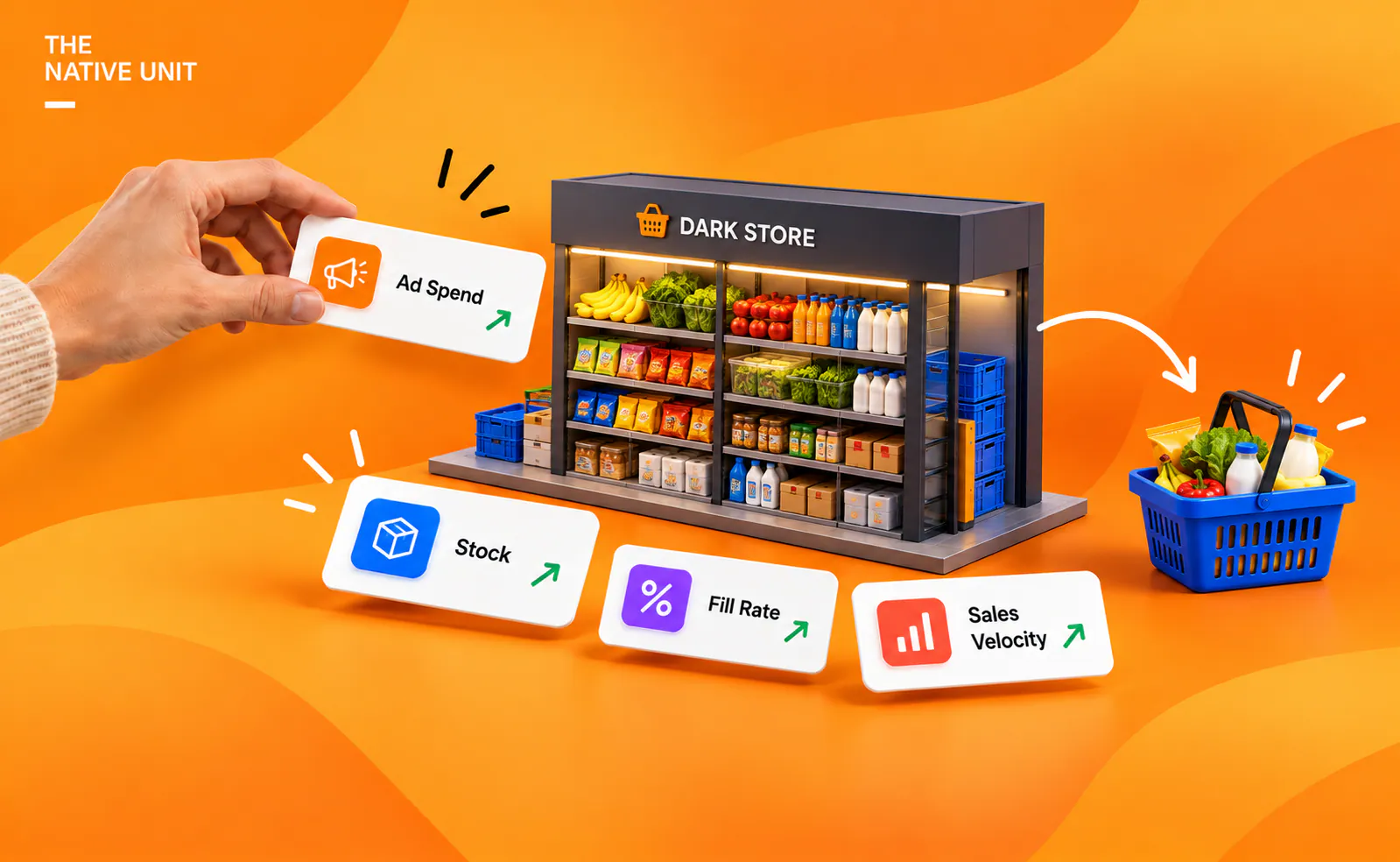
Blinkit ads run through Brand Central, Blinkit's self-serve platform, where any brand with a live catalogue can start a campaign with no fixed minimum. Instamart ads sit behind its brand portal and Swiggy's brand team. In both, the click price matters less than whether the product is in the dark store when the shopper taps.
A Brand Manager or COO at a D2C brand on Blinkit and Instamart often sees ad spend and stock in two different reports. That is the Q Commerce Visibility bottleneck: listings underperform because they do not sell fast. An ad on a product that is out of stock makes the problem more expensive.
The money in this channel is growing. Zepto earned ₹1,635.73 crore from advertising in FY26, 7.2% of its operating revenue, according to Inc42's August 2026 analysis of its filings. Platforms now earn real money from your bids.
NativeUnit's Customer Acquisition Engine runs paid ads, and its Analytics & ROI Engine reads what each ad rupee returns after stock. This guide covers what each platform says about ads, a break-even test for availability, and how to release spend while stock is still being fixed.
Short answer: should a brand run Blinkit and Instamart ads before its stock is reliable? Run them only in cities where your in-stock share is above the break-even line for your bid. Keep every other city at zero ad spend. The line is the click price divided by the conversion rate times the contribution you earn per order. Spend the rest on replenishment, because an ad cannot sell a product the dark store does not hold. |
TL;DR
Blinkit's Brand Central is self-serve for any brand with a live catalogue, with no fixed minimum and city-level targeting.
Instamart ads run through a brand portal, and sources disagree on whether they are self-serve, so check your account.
Neither platform publishes a rate card for clicks or banners that we could find.
Blinkit's own average ROAS claim is 3.8x, while a small-brand founder reported 1.2x to 1.5x.
Stock sets the return: with the same bid, a product can earn money at 90% in-stock and lose it at 70%.
In the worked example, the Stock Line is 71%: below it, a ₹3 click loses money.
Cap daily budget at what your spare stock can sell, and release spend city by city.
Next step: write the Stock Line for your top five SKUs before you top up an ad wallet.
Book the 10-minute audit and bring your top five quick-commerce SKUs → |
Can You Run Ads on Blinkit and Instamart? What Each Platform Says
Yes, on both, but the two platforms are not equally open. Blinkit publishes the most on its own page, and Instamart publishes little outside its portal login.
| Blinkit | Instamart |
Where ads are run | Brand Central, a self-serve platform | The Instamart brand portal, which has a login and a get-started page |
Who can advertise | Per Blinkit, any brand selling on Blinkit with a live catalogue | Sources conflict: one agency says it runs through Swiggy's brand solutions team, and a how-to guide describes a portal login |
Formats | Eight, named by Blinkit: Prime Banner, Product Booster, Recommendation Ads, Product Shelf, Brand Spotlight, Brand Store, E-com Shelf and Listing Spotlight | Agency guides list sponsored listings, banners and brand stores, not Swiggy documentation |
Minimum | No fixed minimum, per Blinkit | Agency guides quote ₹15,000 for sponsored listings, not a Swiggy price list |
Targeting | City, shopper cohort and time of day, per Blinkit | Market coverage is mentioned in guides, and we could not confirm city-level controls |
Reporting | Impressions, clicks, conversions, ROAS and brand search lift, with paid and organic side by side | Not described on open pages |
A Founder should read the Blinkit column as Blinkit's own claims and the Instamart column as a to-do list. Ask your Swiggy account contact what your portal actually lets you do.
How Much Do Blinkit and Instamart Ads Cost?
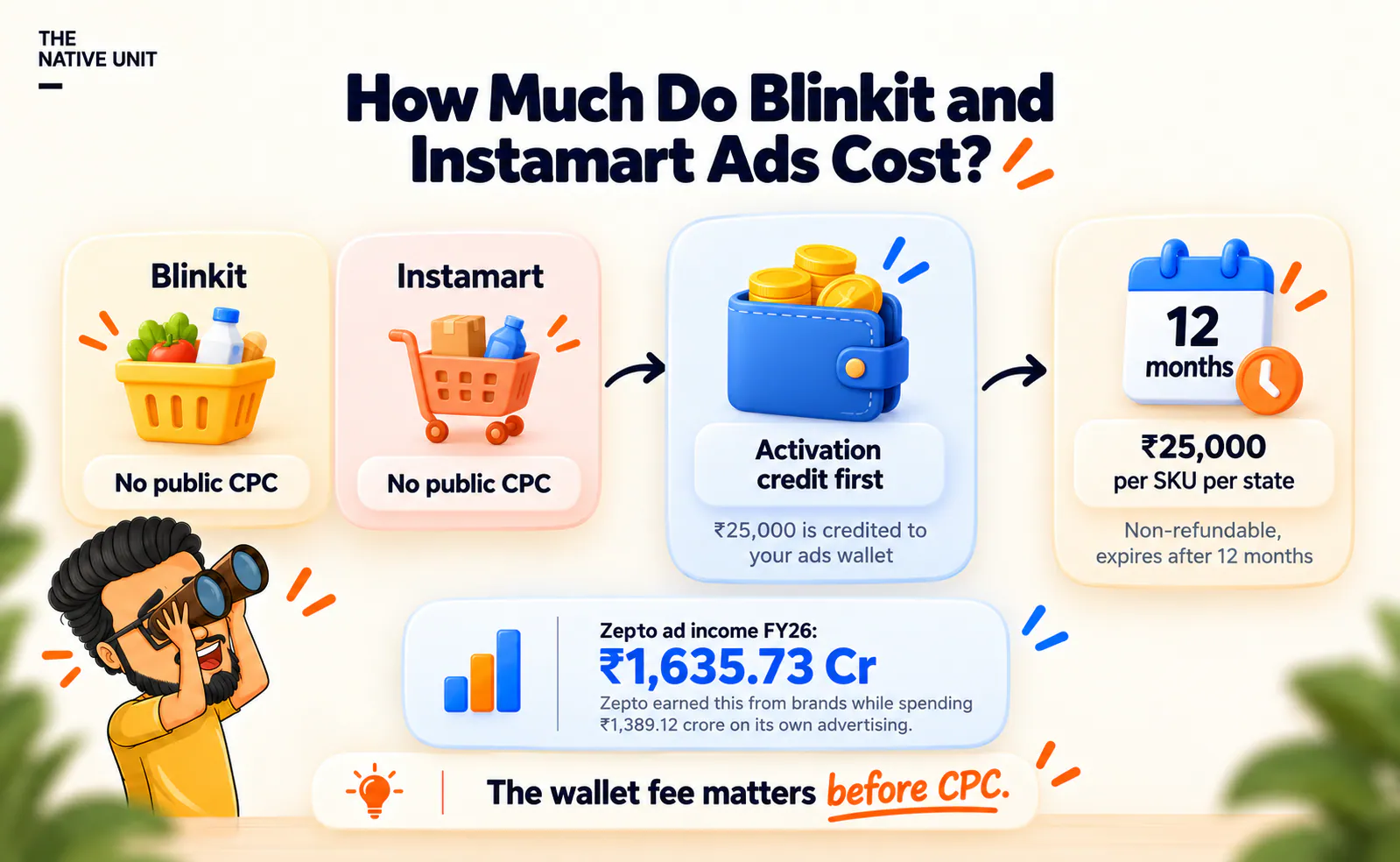
Neither platform publishes a click price. Blinkit says you set a daily budget and bids, and pay for clicks or impressions depending on the format. A Marketing Director should treat every blog's "₹2 to ₹15 a click" as an anecdote.
There is a second cost that comes first. Blinkit's Seller Hub fee page says the product ID activation fee is credited to the ads wallet. Sellers told Storyboard18 in July 2025 that it ran ₹25,000 per SKU per state, non-refundable, expiring after 12 months. Blinkit did not respond to the publication.
📊 ₹1,635.73 crore: Zepto's advertising income in FY26 Zepto earned this from brands while spending ₹1,389.12 crore on its own advertising. For a Brand Manager, the quick-commerce platforms are now ad businesses, and your wallet is part of their revenue. Source: Inc42 |
If that fee sits unspent in a wallet with an expiry, it is a deadline. A COO or Ops Head should find out the date for every SKU and state before planning a budget around it.
Why Stock Decides Your Ad Return Before Your Bid Does
The assumption is that quick-commerce ads are a bidding game, won by the brand that raises its bid. The reality is that the dark store sets the return, because a click on a product that cannot be delivered earns nothing.
There are two ways stock leaks ad money, and the platforms behave differently. One agency says an ad for a product the store cannot supply spends the click and loses the order. Another guide says Blinkit ads run only where the product sits in the nearest dark store, so the wallet idles instead. Either way, you have paid for a slot and lost the sale, and Blinkit does not state which applies in your account.
The gap between promise and return is wide. Blinkit's page claims an average 3.8x ROAS for brands on Brand Central. SouLilly Toys told Storyboard18 that ROAS rarely goes beyond 1.2x to 1.5x for small brands.
The pattern we see in D2C brands entering quick commerce is that the ad budget is approved long before the replenishment plan. Marketing asks for more wallet, while operations asks for more cash for stock, and the two never share a number.
⚠️ Warning Blinkit buys and owns the stock in its dark stores, according to Zerodha's Daily Brief. Your availability therefore depends on how fast it reorders from you. Ask whether your reports show in-stock share by city before you read any ROAS. |
The Stock Line: The In-Stock Share Where Your Bid Breaks Even
Every bid has an availability below which it loses money. The Stock Line is that share: the click price divided by the conversion rate times the contribution you earn per order.
Stock Line = click price ÷ (conversion rate × contribution per order before ads)
|
The inputs below are illustrative, so substitute your own. Take a ₹349 personal-care SKU that earns ₹70 per order after Blinkit's margin, product cost and freight to the dark store. Assume a ₹3 click and a 6% conversion from click to order. The Stock Line is ₹3 ÷ (6% × ₹70), which is 71%.
In-stock share at the targeted dark stores | 100% | 90% | 70% | 50% |
Orders per 100 clicks | 6.0 | 5.4 | 4.2 | 3.0 |
Platform ROAS at a ₹3 click | 7.0x | 6.3x | 4.9x | 3.5x |
Contribution earned per ₹1 of ads | ₹1.40 | ₹1.26 | ₹0.98 | ₹0.70 |
Profit per ₹1 lakh of ads | +₹40,000 | +₹26,000 | -₹2,000 | -₹30,000 |
Break-even ROAS here is ₹349 ÷ ₹70, or 5.0x, and it does not move with stock. What moves is whether you reach it: the same click clears 5.0x at 90% in-stock and misses it at 70%. This is the break-even logic of the ROAS Four-Term Test with availability added as a term.
Raise the bid to ₹4 and the Stock Line becomes 95%. A higher bid needs a more reliable shelf. The table assumes ads keep serving when the product is out and that conversion does not change with price.
What to Spend While Stock Is Still Being Fixed
Spend nothing where you are below the line, and spend carefully where you are above it. A Founder can do this in five moves.
Measure in-stock share by city. Use your PO fill rate and whatever stock data your portal shows. If your reports hide it, ask your account manager for it in writing.
Compute the Stock Line per SKU at the click price you expect, using the formula above.
Release a proof budget only in cities above the line. Blinkit documents city-level targeting, so keep ads out of cities where stock is thin. Instamart's city controls are not confirmed on open pages.
Cap the daily budget at what spare stock can sell. The cap is spare units per day times click price, divided by conversion rate. With 40 spare units, a ₹3 click and 6% conversion, that is ₹2,000 a day.
Scale a city after two weeks above the line. Add banners, Brand Store or Instamart placements only after search ads clear the line.
Agency guides quote a starter budget of ₹25,000 to ₹50,000 a month for Blinkit. That is the agency's figure, not Blinkit's, and it ignores your stock. Set your proof budget from the cash you can afford to lose. Fund replenishment first, because the cash needed before the first payout is what keeps stock on the shelf.
Where Meta CPAS Fits Beside In-App Ads
Meta's Collaborative Performance Advertising Solution, or CPAS, lets a brand use a retailer's catalogue to run Facebook and Instagram ads. Those ads send shoppers to the retailer's store. Storyboard18's report on the WPP Media and Meta playbook says Britannia ran it across Blinkit, Swiggy, Zepto and other partners. It used real-time retailer data sync and geo-optimisation.
For an Analytics & ROI lens, the point is geography. A CPAS campaign that can be limited by location can be limited to cities above your Stock Line. Check with Meta and the retailer whether your account supports it, because the report gives no setup steps.
Hiring Help: What a Quick-Commerce Partner Must Show You First
A partner that runs your Blinkit and Instamart ads can raise your visibility and your losses at the same speed. Before you sign, ask for the report that matters most, not the dashboard that sells best.
Show me in-stock share by city for the last four weeks. A partner that starts with ROAS has skipped the line.
Show me my Stock Line per SKU. If it cannot compute one, it is bidding blind.
How are you paid when spend rises? The answer should say whether the fee grows with the wallet.
Who holds the portal access and keyword data if we part? Get it in writing, because the Second-Agency Problem starts when each partner owns one console.
How do you report beside Amazon, Flipkart and my own site? Quick commerce is one line of a blended number.
Organic position also depends on velocity and availability, and the Blinkit and Zepto ranking guide covers what to fix before ads can help.
Want One Number for Stock, Spend and Margin?
For a Founder, topping up an ad wallet takes a payment. Owning the number that joins stock, spend and margin takes someone who reads all three each week.
NativeUnit builds growth systems for D2C and FMCG brands. The Customer Acquisition Engine and the Analytics & ROI Engine cover paid ads and margin reading. They exist for brands that run every channel with no one owning growth. Our published case studies do not describe quick-commerce advertising results, so we make no Blinkit or Instamart claim.
When You Should Not Run Quick-Commerce Ads Yet
Ads amplify a shelf, full or empty. A Brand Manager should be honest about which of these is the real situation:
You do not know your in-stock share by city. Without it, ROAS is a number with no cause.
Your replenishment depends on cash you do not have. Fix the first-PO gap before you fund a wallet.
You are live in a few dark stores. Too little distribution gives ads nowhere to sell.
You cannot compute contribution per order. Without it, no click price is good or bad.
Your real leak is acquisition cost across channels. Start with the CAC reduction playbook before adding another wallet.
Conclusion
Blinkit and Instamart ads cost whatever the auction charges, and they pay back only when the product is in the dark store. The Stock Line tells you where a bid breaks even, and a city-by-city release keeps spend where stock can sell it.
Q Commerce Visibility eases when stock and spend share one owner. The Customer Acquisition Engine runs the ads, and the Analytics & ROI Engine owns the line they are judged against.
Fix my quick-commerce numbers: start with a 10-minute audit → |
Frequently Asked Questions
Yes. Blinkit says any brand selling on Blinkit can advertise through Brand Central once its catalogue is live. Campaigns run on search, category pages, recommendations and brand stores, with city, cohort and time-of-day targeting. Check your own account for the formats it offers.